

I had been aiming at nothing for twenty years. Not at a target, not at a line, not even at a specific tree. I would walk into the ball on the range, look up at whatever was out there, and swing. Then I would watch the ball start a good eight yards right of where I swore I was pointed and blame my swing.
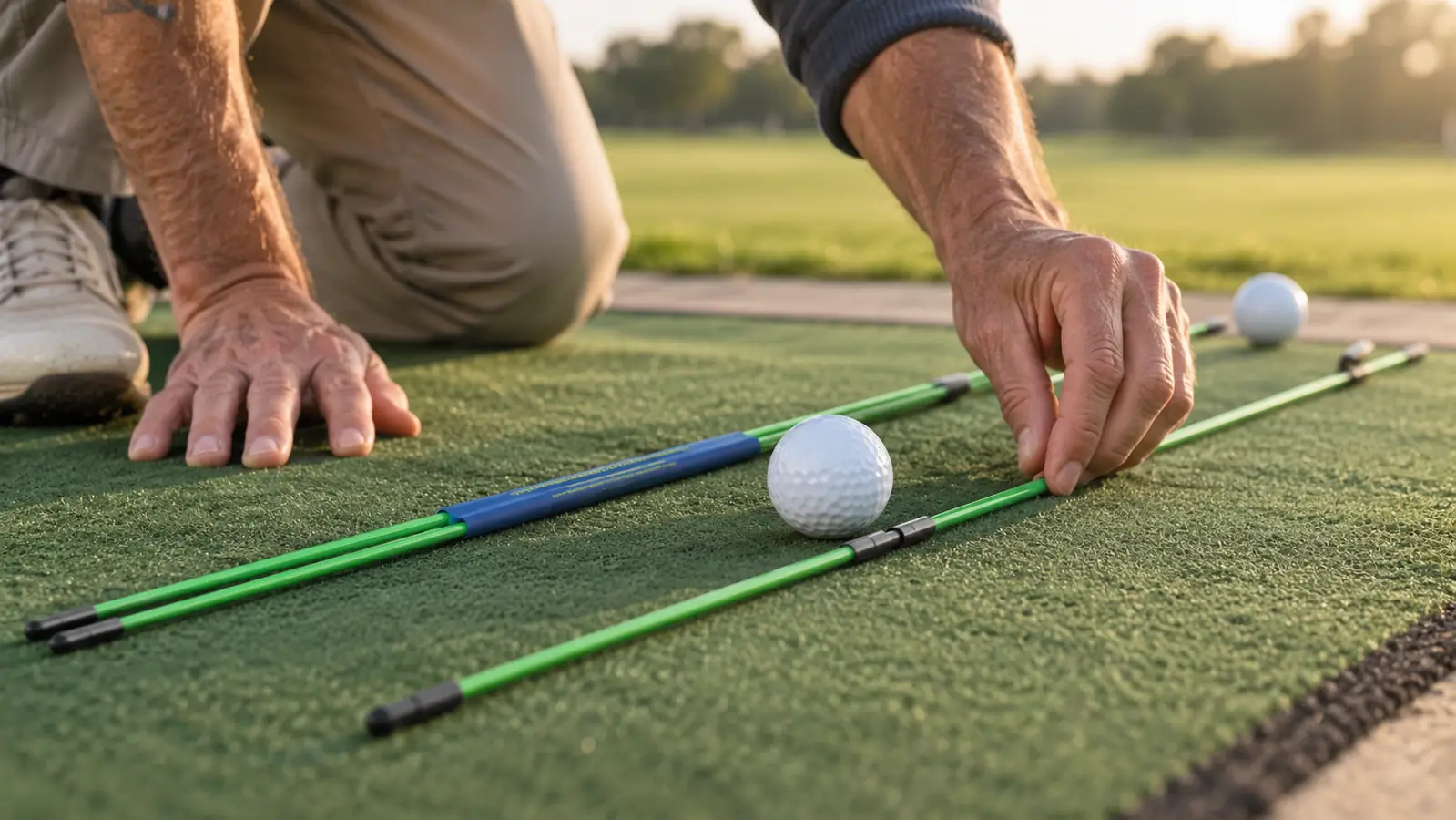
The swing was mostly fine. The problem was that my feet, my hips and my shoulders had been pointing at three different places, and I had no way to see it because I was standing inside the mistake. Two sticks laid on the ground show you what your eyes cannot. The Seticek 2 Pack 48 inch alignment sticks are the ones that live in my bag now. They fold from 48 inches down to 17 inches, they weigh 91 grams each, and they are small enough that I forget they are in there until I need them.
What follows is the five step version of what I do with them, in order, roughly the way I do it on a Saturday morning. None of it is complicated. All of it is boring in the way that actually helps.
Two sticks on the ground. The first honest look at your aim you have had in years.
The Seticek 2 Pack folds to 17 inches, weighs 91 grams per stick, and rides in a golf bag pocket without adding anything you will notice. Two sticks is the number these drills actually need.
Amazon Check Today's Price on Amazon →Why My Setup Kept Drifting and Nobody Told Me
A golf swing is fast and a setup is slow, and most of us spend every minute of practice time on the fast part. I took lessons. I did the drills. Nobody ever put a stick on the ground and said look where your toes are pointing compared to your shoulders.
Here is the thing that finally landed for me. Aim is not a feel. It is a geometry problem, and geometry is easier to check with a straight line on the turf than with a sensation in your hands. Once I could see the line, I could see how far off I was. It was a lot. My feet pointed at the green and my shoulders pointed at the cart barn. That is not a swing flaw. That is a setup flaw, and it costs almost nothing to fix.
Step 1: Lay the First Stick Down on Your Toe Line
Pick a target. Not a vague direction, an actual thing. A flag, a specific tree, the corner of a fence. Then lay one stick on the ground along the line between your ball and that target. I lay mine just outside where my toes will sit.
Set up to a ball and look down. The stick should run along your toe line, parallel to it. If it looks like it is pointing left of your target, you are about to set up closed. If it looks right, you are open. Thirty seconds of looking down will tell you more than a hundred range balls hit without it.
One idea that helped me more than any drill: stop aiming your body at the target. Your body lines run parallel left of the target line, not at it. The stick represents the target line, and your toes sit a few inches behind and parallel to it. Once I understood that, the stick stopped feeling like it was pointing somewhere wrong.
A practical note. The first few times, the stick will feel wrong even when it is right, because your body is used to the old line. Trust the stick. Your eyes adjust in about a bucket. Mine took two.
Step 2: Set the Second Stick Perpendicular to Fix Ball Position
Lay the second stick across the first one at a right angle, right at the ball. Now you have a cross, and the front to back arm of the cross shows you where the ball sits in your stance.
This matters more as you get older, because most of us start creeping the ball back in the stance without noticing. A ball too far back with a driver turns into a low pull. A ball too far forward with a short iron turns into a thin. The cross makes both visible before you swing instead of after.
With the driver I want the ball forward, off the inside of my lead heel, and the cross makes that repeatable. With a 7 iron I want it closer to center. Without the cross I would drift a full ball width over the course of a bucket and never notice until the scorecard told me.
I use it mostly with the 7 iron and the driver, the two clubs that lie to me the most. Ten balls to reset my eye, then I move the cross and hit a few wedges.
Step 3: Check Your Shoulders Against the Line, Not Your Eyes
This is the step that actually changed my ball flight. Take the second stick and hold it across your chest, or across your forearms if that is easier on your back, and set up so the stick is parallel to the ground stick. If your shoulders are square, the two lines match.
Mine did not match. Not close. I had been setting up with my shoulders open to my feet for years, which meant my swing had been compensating for a setup error on every single shot I hit. Fixing the shoulders took one practice session. Getting used to the different ball flight took a month, and I hit a lot of pulls in the meantime while my hands caught up with my eyes.
The same check works on your hips. Hold the stick across your hip bones and look at it against the ground line. My hips were fine. My shoulders were not. Two out of three is not good enough in a setup, which is the whole reason to check all three instead of guessing.
Twenty five years of league golf, a fourteen handicap, and my shoulders had been aiming at the wrong fairway the entire time.
Step 4: Build a Gate to See Your Swing Path
Lay one stick on your target line and the second one outside the ball, about a grip length outside it, parallel to the first. Now you have a channel. Swing through it.
The gate does not fix your path. It shows you your path. If you clip the outside stick on the way down, you are coming over the top. If you miss it by a foot, you are swinging from the inside and the ball is probably starting right of where you think you are aimed.
The gate will not cure an over the top move on its own. Nothing you lay on the ground does. What it does is tell you honestly and immediately whether the move is still there. That is worth more than another twenty balls hit into a net with no feedback at all.
A word on ground conditions. Some players push alignment sticks into the turf. I do not do that with these, because they are glass fiber, and glass fiber does not like being bent and leaned on. I would rather they stay straight. On a range mat or firm turf, laying them flat works fine and you never have to dig a hole or repair a green.
Step 5: Carry the Routine to the Range and the Course
The last step is the one people skip. The sticks only help if you use them before the round, not after it.
My Saturday morning range routine is the same every week. I lay both sticks on the toe line and the cross, hit ten balls with a 7 iron while checking the shoulder line, then drop the cross stick and keep the toe line one for the rest of the bucket. It adds about four minutes to a session, and it is the best four minutes I spend all week.
Before league on Thursday, I lay one stick down on the first tee if the group is not waiting on me, take two looks, and pick it up. That is it. The point is not to become the guy doing drills on the tee box. The point is to give my eyes one honest reference before I trust them for eighteen holes.
How the Seticek Sticks Have Held Up
I have had this pair in the bag for two seasons of league golf and a lot of Saturday range sessions. They fold to 17 inches and go in the long pocket next to the umbrella, and the fold has not loosened on mine. The glass fiber has not warped or bowed, even sitting in a hot car through an Ohio July, which is more than I can say for a couple of plastic training aids I have owned and thrown away.
They are 91 grams each, which sounds like nothing until you have carried two steel rods around for a season. The finish has scuffed at the ends from being dropped on cart paths. That is cosmetic and it does not affect the only thing I ask them to do, which is lie flat and be straight. At 4.5 stars across 670 ratings, the reviews mostly say the same thing. Nobody gets excited about alignment sticks. People are just glad they work.

What Else Helps
The sticks show you the problem. They do not loosen anything up. The other half of my setup work is boring. I take half as many full swings on the range as I used to, and I spend the difference on wedges and putts. My lower back tightens up after a big bucket and it is worst the next morning, so a smaller bucket with a purpose beats a big one that leaves me stiff on Friday.
The garage net is where the real work happens. Hitting net and mat, twenty minutes, no ball flight to chase, which means I can pay attention to the setup instead of the result. There is nothing to impress and nobody watching, and that turns out to be the best environment for changing something as dull as where your shoulders point.
The same two sticks work for putting. Lay one down on your intended line, then check that your shoulders and the putter face are square to it. I do this on the short strip of grass in the backyard, ten minutes, no hole required. It is the least popular practice in golf and it has saved me more strokes than any bucket of drivers ever did.
Two honest caveats. If you have never had a lesson, get one before you buy any training aid, because a professional can spot in five minutes what you will chase for a season. And if your back is giving you more than ordinary stiffness, see your doctor. Alignment sticks are a geometry tool, not a medical device, and no piece of equipment is going to fix a back that needs looking at.
What I Liked
- Folds from 48 inches to 17 inches, so it fits in a golf bag pocket instead of rattling around the trunk
- 91 grams per stick, light enough that you forget you are carrying them
- Two sticks in the pack covers the toe line, the cross and the gate drills without buying twice
- Glass fiber holds its shape and does not bow the way softer aids do
- Works for full swing, chipping and putting with the same two sticks
Where It Falls Short
- No warranty, so a snapped stick means buying another pack
- Glass fiber should not be jammed into hard ground and leaned on
- They do nothing at all if they stay in the bag, which is on you, not them
- The finish scuffs at the ends with normal use
The simplest fix in golf is a straight line on the ground.
Two folding sticks, 48 inches open and 17 inches folded, 91 grams each. Lay them down once and you will see your setup the way your playing partners already see it.
Amazon Check Today's Price on Amazon →