

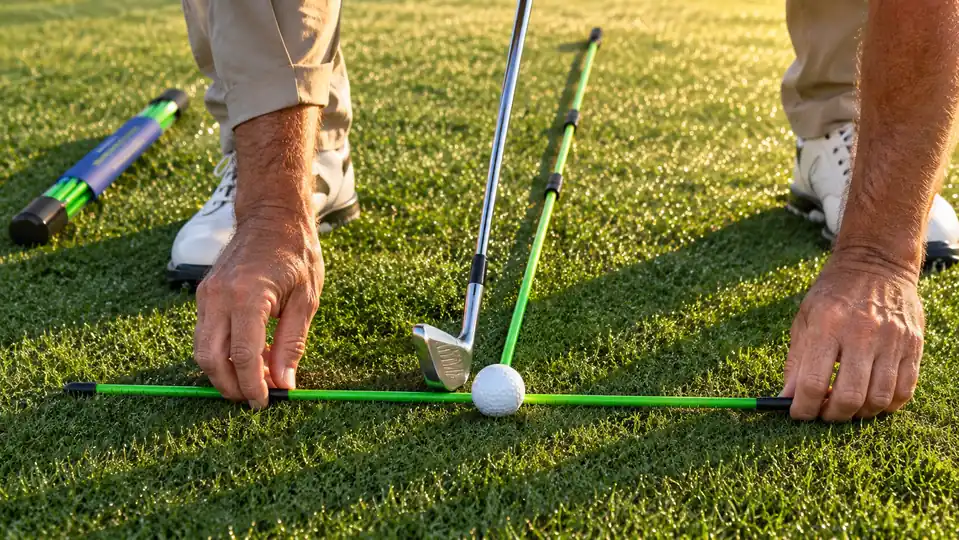
Twenty-five years of Thursday league golf and I had never checked my shoulder line with anything better than my own eyes. That is a poor instrument. Your eyes sit on your head, your head sits on your neck, and by the time you have walked in from behind the ball and settled your feet, the line you picked is mostly a guess with confidence behind it. A teaching pro outside Newark ended the argument for me with two sticks and about ninety seconds. He laid one on my target line, one across my toes, and told me to look down at my shoulders. They were aimed a good fifteen yards right of my feet. I had been aiming that way for years and calling the result a fade. The Seticek 2-pack is the version of that lesson that lives in my bag now: two 48-inch glass fiber sticks, 91 grams apiece, folded to 17 inches when I am not using them, and nothing on them that needs a charge.
So here is the short answer before the long one. Alignment sticks and laser aim trainers are not the same tool in different packaging. The sticks show you where your body is pointed. A laser trainer shows you where the club or the putter face is pointed. One is a body check, the other is an aim check, and most of the golfers I know who got frustrated with either one bought it expecting the other. I have used the Seticek pair through two seasons of garage practice and Saturday range sessions. I borrowed a friend's laser trainer for a month of putting work on the strip behind my shop. Neither is a gadget I would call life changing. Both earned a place, and they earned different places.
| Seticek Alignment Sticks | Laser Aim Trainer | |
|---|---|---|
| What it shows you | Where your shoulders, hips and feet are lined up | Where the club or putter face is pointed at the target |
| Body alignment | The whole job. Two sticks give you a body line you can see | Shows the aim, not the body line that caused it |
| Aim and putter face | Only as honest as the line you laid down yourself | Instant read from a beam hitting a wall or a target |
| Power | None. Glass fiber, nothing to charge | A battery to keep topped up |
| Setup time | Lay them down and hit a ball | Charge it, mount it, aim it at something first |
| Bright sun | Nothing to wash out | Beam gets hard to see in full afternoon sun |
| Putting start line | Works as a gate on the practice green | Better at showing a stroke that starts off line |
| Storage and knocks | Folds to 17 inches, but fiberglass can splinter | Small unit, but electronics take a knock badly |
Where the Seticek Alignment Sticks Win
My miss has never been a face problem. It is a setup problem. I get lazy with my feet, my right shoulder drifts open, and I spend the whole downswing saving a swing I set up wrong. Two sticks on the ground make that impossible to ignore, because now there is a line where my shoulders are meant to be and a line where they actually are, and I can see both from the same place I stand to hit the ball. Seticek's listing describes the job plainly: keep the shoulders lined up with the feet and hips. That is exactly what the pair does, and it is the reason I still carry them after the novelty wore off.
The second reason is that they never ask anything of me. No charging, no battery, no lining a beam up with something across the garage before I can start. They live in the side pocket of my bag. On a dewy Saturday morning I pull one out, lay it on my target line, lay the second across my toes, and hit six or seven balls with an iron before I touch a driver. Wind does not disturb them. Early sun does not wash them out. A topped ball that knocks one sideways costs me four seconds and I set it back down.
The first week I owned them I did something I would recommend to anyone, and it involved no golf balls at all. I laid one stick down my target line in the garage, laid the second across my toes, and set up to the mat and simply looked down at my shoulders for a count of five. Twenty times in a row. What I found was that my right shoulder crept open by about the width of a golf ball whenever I got tired, and it crept open further by the fifteenth rep. Twenty setups cost me six minutes and told me more about my address position than a season of range balls had. By the end of that week I could feel the open shoulder before I looked down, which is the whole point of a reference. It stops being a stick on the ground and starts being a thing your body knows.
The honest downsides, because there always are some. Fiberglass does not enjoy being leaned on, the listing carries no warranty, so I treat them as a straightedge rather than a walking stick. The folded length is 17 inches, which fits a bag pocket, but the pair still takes up room, and in a Sunday bag with four clubs you will feel them rattling against the shafts. The bigger one is that they only report what you set up. Lay them down carelessly and you have built a careless reference, and you will spend a month practicing to a wrong line without ever knowing it. I check mine against the straight edge of my mat now and then, mostly because I knocked one crooked with a fat wedge shot last spring.
Where Laser Aim Trainers Win
Where the laser wins, and I will say it without hedging, is the putter. On the strip behind my shop I set the trainer behind the ball, watched the beam land on the baseboard, and could tell within one stroke whether the face was square to the line I had picked. That is a read the sticks cannot give with the same precision. Sticks show the line. The beam shows the face. If your putts start right and keep starting right, that difference is worth paying for.
The month I had my friend's laser I did learn one thing worth passing along. I set it up on the strip, aimed the beam at the baseboard, and rolled putts from six feet. For the first week the dot landed in the same half-inch spot over and over and I felt like a good putter. Then I moved the ball back a foot and the dot started leaking right by about two inches, every single time. Nothing about my hands had changed. What changed was that I had to make a longer stroke, and the longer stroke exposed a face that was not quite where I thought it was. That is the kind of thing a beam catches and a stick cannot. I would not have found it on my own in a year of putting without it.
What the beam does not show is why. It reports where you aimed. It does not report that your shoulders were aimed somewhere else, or that your hips came open and your hands rescued the stroke at the last instant. I spent a month chasing the dot and got very aware of my face and no better at my setup, which is the wrong order of operations. There are practical costs too. You charge it, you aim it at something, and on an outdoor green in bright afternoon light the beam is harder to pick up than you would like.
None of that makes a laser trainer a bad purchase. It makes it a specialist's tool, and I mean that as a compliment. When I am working on start line and nothing else, the laser is faster and more honest than anything I can do with sticks. When I am working on why my start line wandered in the first place, it is the wrong instrument, and no amount of extra putts with it will tell me that my feet were pointed at the wrong county.
The Part Neither One Fixes: My Back
I should be clear about what the sticks did for my lower back, which is nothing directly. My back tightens up after a long range session and it is worse the next morning. My doctor looked at it years ago and called it ordinary muscle strain and stiffness, nothing surgical, and that is the whole of my medical history on the subject. Setting two sticks on the mat is not therapy, and I would not tell anyone it is.
What changed is the number of swings I take that I have to save. When my setup is lined up, I make a turn instead of a correction, and I can hit fifteen balls with a purpose instead of forty while I hunt for a feel that keeps moving on me. Fewer swings and less twisting around to check my aim from behind the ball is not a cure for anything. It is less wear on a 57-year-old back on a Saturday morning, and I will take that trade every week.
Here is the part that took me a season to see, and it matters more at my age than any swing thought. The thing that hurts my back is not the swinging. It is the hunting. Forty balls spent searching for a feel, walking back two steps to check my aim, walking in, setting up again, hitting a bad one, repeating the loop. That walk in and out is the part that stiffens me up, not the swing itself. When the sticks are down I hit fifteen balls with a purpose and I go in. Fewer reps, fewer twist and check cycles, and I get to my coffee before it goes cold. That is the whole of my health claim and I am not going to dress it up any bigger than that.
The setup check that never needs charging
Seticek 2-pack: two 48-inch glass fiber sticks, 91 grams each, folded to 17 inches for a bag pocket. Lay them down, look at your shoulders, hit a ball.
Amazon Check Today's Price on Amazon →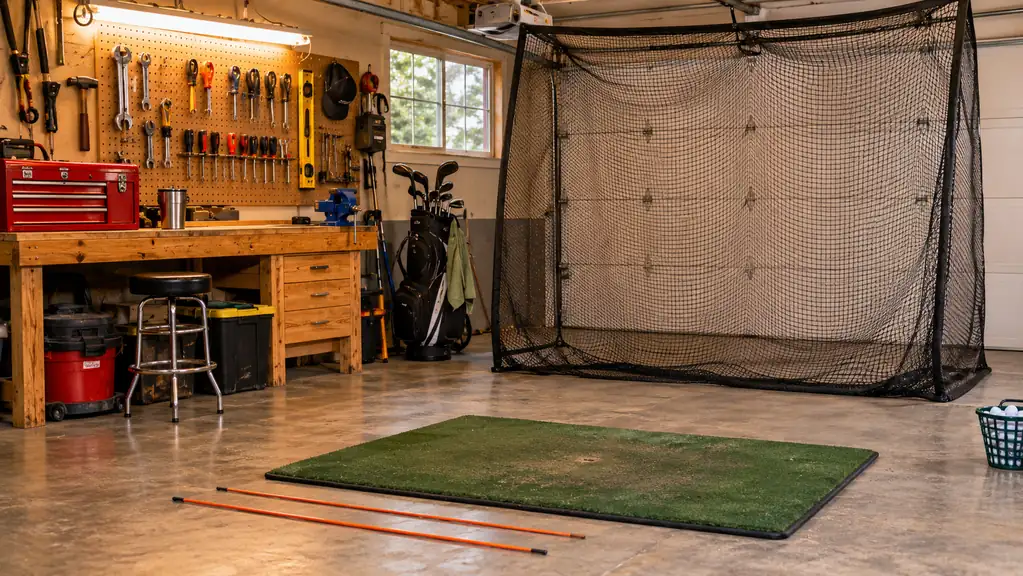
What I Do With Them Now
My Saturday routine is the same now. Two practice swings with a stick across my toes to check my feet, one down my target line, six balls with an 8 iron, eight with a mid iron, and a handful with the driver. Then the sticks go back in the bag and I go play. On the putting strip at home I lay one stick down as a gate about a putter head wide, which is a simple way to catch a stroke that wanders off the line. On the practice green before league I do the same gate with four balls, and if two of the four roll through clean I stop and go hit my tee shot. Ten minutes of checks, not a training program.
If I am working on face angle, I borrow the laser. If I am working on where my body is pointed, the sticks come out. If I only had room for one, it would be the sticks, because my bad rounds come from bad setup far more often than from a face that is two degrees open. That is my pattern, not necessarily yours. Watch where your ball actually starts for two or three rounds and work backward from there. If it leaves the club on line and then curves, you have a face or path issue. If it starts off line the moment it leaves the club, you have an aim issue, and aim issues usually start in the feet and the shoulders.
Who Should Buy Which
Buy the alignment sticks if your shoulders and hips drift and nobody has ever shown you a reference for it, if you practice in a garage or on a strip of backyard, or if you want a check that never needs charging. There is a practical point for the over-50 crowd too. Getting down to the ground to fiddle with a small electronic unit is its own chore, and the sticks can be set with a foot and picked up with one hand or hooked with the end of a club. The Seticek pair folds to 17 inches, so it goes in the bag and stays there instead of living on a shelf in the garage.
Buy a laser trainer if your miss is a start line problem, especially on putts, and you have a flat indoor surface with something to catch the dot. It also suits the golfer who likes numbers and wants to watch a face angle change in real time. Plenty of good players carry both, and it is not hoarding. Sticks for the body, laser for the face. If you are choosing one this season, choose the one that matches the miss you actually have, and give it six weeks before you decide it did not work.
My shoulders were aimed fifteen yards right of my feet and I had spent a decade calling the result a fade.
Fix where you are pointed before you fix the face
The Seticek pair is the check I run before every range session: 48 inches unfolded, 17 folded, 91 grams a stick, nothing to charge at seven in the morning.
Amazon Check Today's Price on Amazon →