
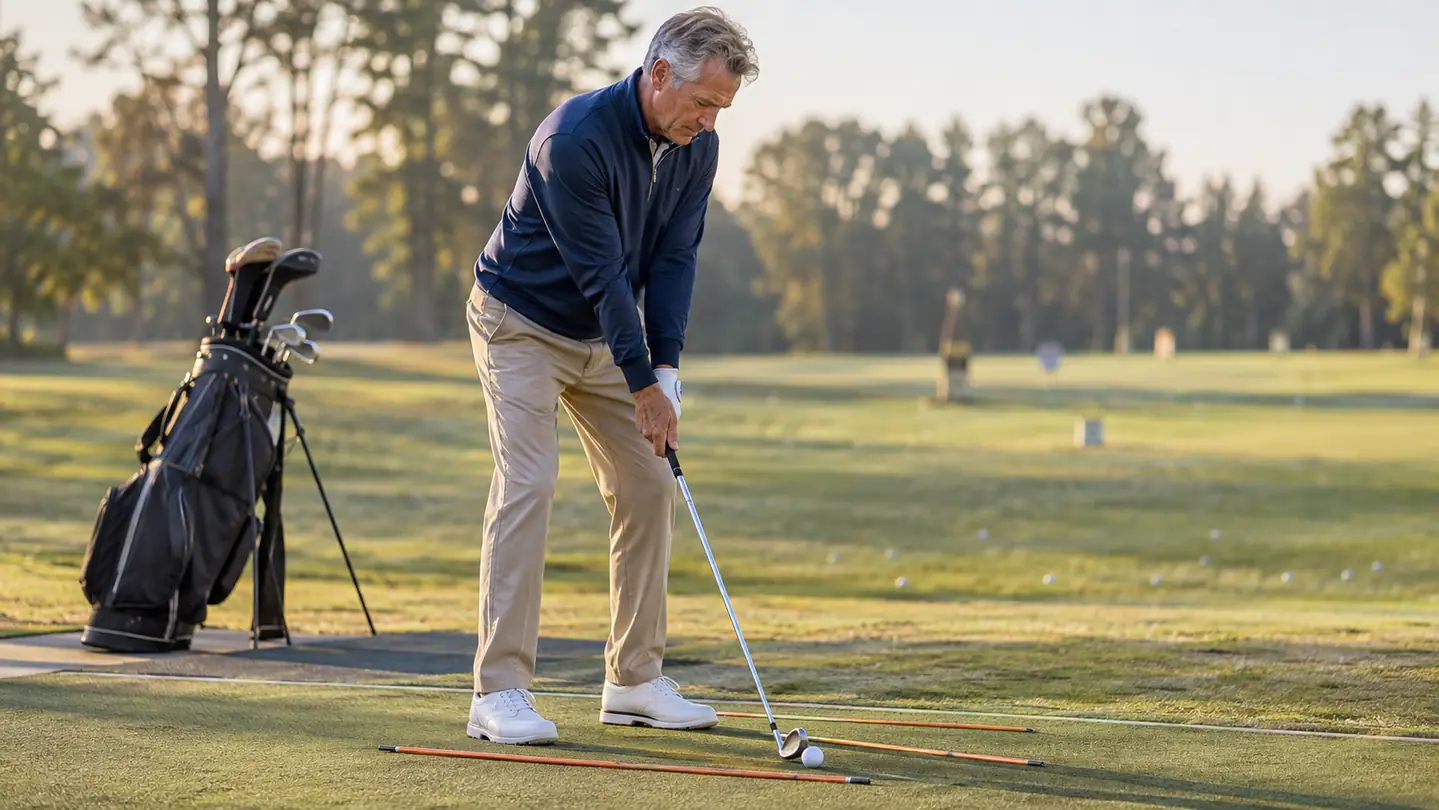
I bought the Seticek alignment sticks on a Thursday night after a league round where I hit four tee shots in a row off the same bad setup. Not four bad swings. One bad setup, repeated. My shoulders were aimed a good twenty yards right of where my feet were pointed, and I had been doing it so long it felt square. That is the trouble with a misaligned address position. It never feels wrong. It just produces the same miss over and over until you want to hand your clubs to somebody else and take up fishing. I am 57, I run a small sign shop in central Ohio, I have played Thursday league for 25 years and I carry around a 14 handicap. I am not chasing scratch. I just want to stop wasting good swings on a bad address position.
The package showed up measuring 17.48 by 1.34 by 1.34 inches, which tells you most of what you need to know about the design. They fold. Unfolded, each stick is 48 inches long. Folded, they are 17 inches, so they drop into a side pocket of my bag instead of riding along the top like a fishing pole. They are glass fiber, each one weighs 91 grams, and the whole package weighs 0.26 kg. There is no warranty on them, and I would rather say that up front than have you find out later. These are two stiff sticks with a fold in the middle. Seticek is not pretending they are anything else, and for the job they do, that is enough.
The Quick Verdict
Two glass fiber sticks that fold to 17 inches and weigh 91 grams each. They will not fix your swing. They will show you that your shoulders and your feet have been arguing with each other for years, and that is worth knowing.
Amazon Check Today's Price →Your Setup Has Been Lying to You Since About 2019
Two 48 inch glass fiber sticks that fold down to 17 inches, so they live in your bag instead of on a shelf in the garage. Lay one on your toe line, hold one across your chest, and find out what your address position actually looks like.
Amazon Check Today's Price on Amazon →How I've Used Them
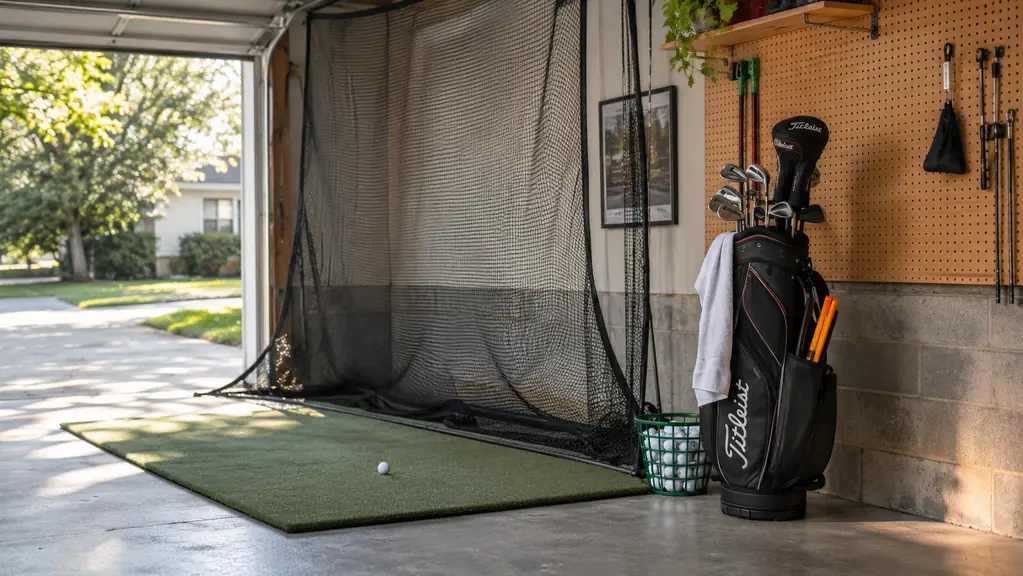
I have a hitting net and a mat in my detached garage, plus a short strip of backyard I use for putting and chipping, and I get to a public range most Saturday mornings. That setup shaped how these got used. The routine I settled into is simple. I lay one stick on the mat along my toe line, parallel to my target, and set my feet against it instead of eyeballing the line from behind the ball. Then I take the second stick and hold it across my chest, against my shoulders, and check whether my shoulder line matches my foot line. It does not match nearly as often as I would like. When I started doing this, my shoulders sat open to my feet on almost every club in the bag, and worse with the driver.
That first month was humbling in a boring way. I was not learning a new move. I was finding out that I had been aiming with my shoulders while my feet pointed somewhere else, then correcting mid-swing without knowing it. Twenty-five years of league golf and I had never once checked it with anything more reliable than a squint from behind the ball. The sticks did not make me better. They made me embarrassed, which turned out to be more useful.
The first proper session was a Saturday in late April, cold enough that I wore a fleece and kept my hands in my pockets between swings. I hit twenty balls with a 7 iron, then stopped and ran the check. Fourteen of those twenty had my shoulders aimed right of my feet. I wrote the number on the back of a range receipt with a carpenter's pencil, because I own a sign shop and there is a pencil in every pocket I have. Fourteen out of twenty is not a small leak. That is the whole boat.
I use the second stick most Saturdays at the range, on the grass, and the whole check takes about ninety seconds before I hit a ball. On the backyard strip I lay both sticks down as a gate for putting, and that is the use I have gotten the most consistent value out of, because a putting stroke is short enough that a bad line is easy to feel and hard to see.
What Two Sticks Actually Do for Your Setup
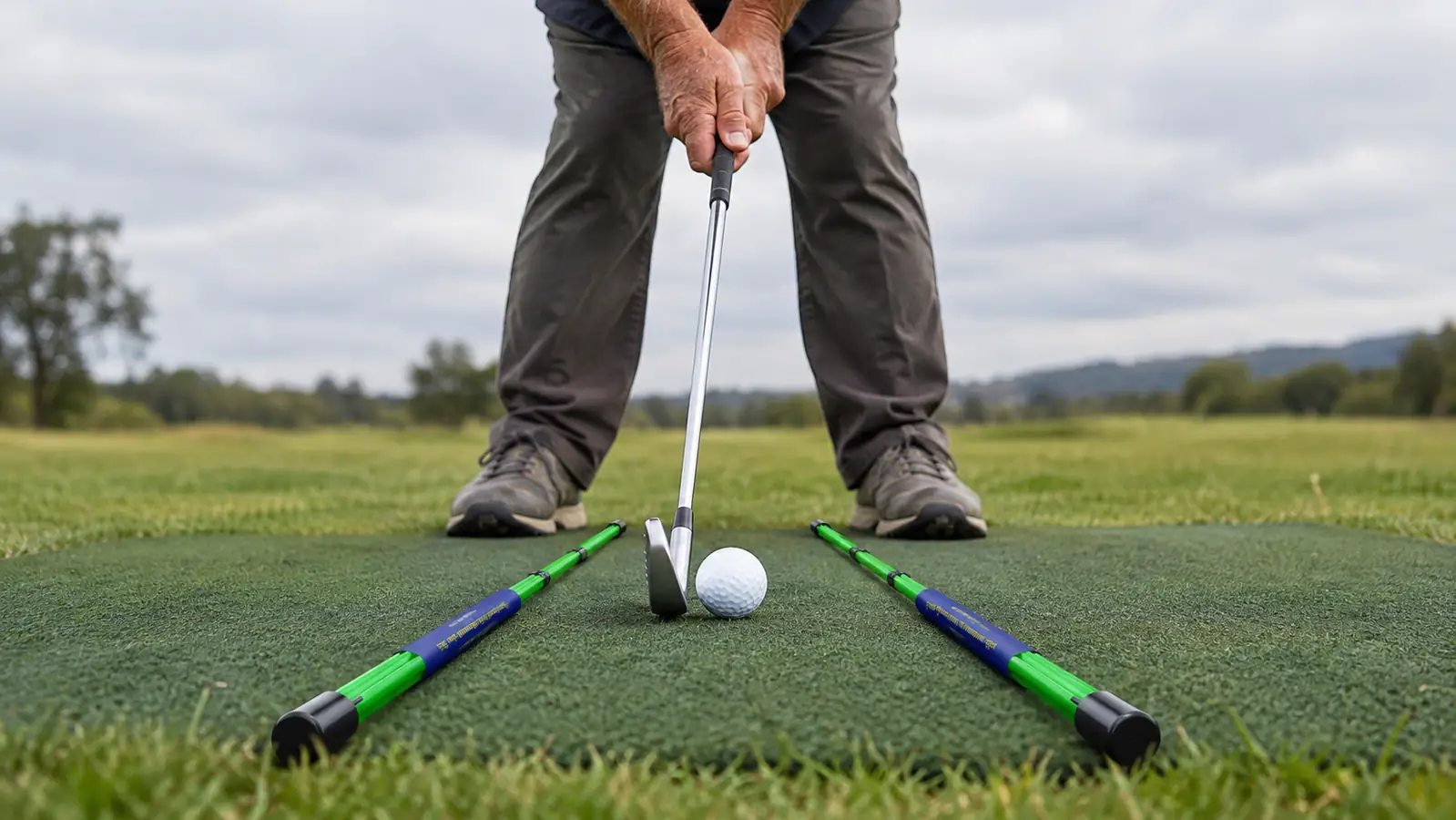
An alignment stick does not train a swing. It is not going to add speed, it is not going to cure a slice on its own, and anybody telling you otherwise is selling something else. It does one thing, and the Seticek listing describes it about the same way: the sticks keep your shoulders aligned with your feet and hips. That is the entire product. What you get is a reference outside your own body, so you can see whether the three lines that matter, feet, hips and shoulders, agree with each other and with the target.
Why that matters is not obvious until you have been wrong about it for a couple of decades. Your sense of square comes from repetition, not from truth. If you have set up slightly open for fifteen years, slightly open is what square feels like, and every correction you make on the course is really a correction away from your target. The stick does not care what feels right. It just lies there and shows you. On the grass at the range I had to accept that my shoulder line was consistently to the right of my foot line, which explained a ball flight I had been blaming on my hands for years.
The second use is ball position, and this one surprised me. With one stick laid down perpendicular to my target line, I get a fixed mark to measure the ball against for each club. My ball position had been drifting forward through a round without me noticing, which turns a decent swing into a thin shot by the fourteenth hole. That is not a swing fix either. It is just removing a variable. Two sticks is what makes this work, because one stick gives you a line and the second gives you the cross reference.
Here is how I actually measured it. I laid the second stick perpendicular to the toe line, right at the front edge of my stance, and used it as a fixed mark. With the 7 iron the ball sits about half a ball inside that mark. With the driver it sits a full ball forward of it. I wrote both numbers on the same receipt. Three weeks later the driver ball position had crept back to where the 7 iron sits, and I would never have caught that by feel alone.
The Folded Length Is the Quiet Feature
Forty-eight inches unfolded is the right length for this job. It has to be long enough that you can stand behind the ball, look down your target line, and see the stick running out past your feet rather than ending under your shoelaces. Anything shorter and you are back to squinting. So the length is not a selling point, it is a requirement, and Seticek met it.
The folding is the part I did not expect to care about and now do. A 48 inch stick that does not fold is a nuisance. It rides above your irons in the bag, it catches on the car ceiling, and it gets left in the garage because you cannot be bothered. At 17 inches folded, these sit in a side pocket and go where the clubs go. At 91 grams each, I genuinely cannot tell whether they are in the bag or not when I pick it up. Glass fiber holds a straight line, which is the other thing that matters, because a stick that develops a curve after a season in a hot car is worse than no stick at all.
A small thing that turned out to matter. My bag has one long side pocket, and it is the pocket I used to fill with tees and a spare glove and a ball mark tool. Folded, both sticks go in ahead of all that and I can still get my hand in past them. Unfolded they would have had to go in the top with the irons, which means pulling them out and putting them back every single time I wanted a club out of the bag.
What It Did for My Back, Honestly
I want to be careful here, because my lower back is ordinary muscle strain and stiffness that my doctor looked at years ago, nothing surgical, and it tightens up after a range session or eighteen holes and is at its worst the next morning. Two sticks did not touch that. They are not a treatment and I am not going to pretend they are.
What changed is how I practice. Because the setup check takes ninety seconds and tells me something real, I spend more of a session on slow rehearsal at address and less on raking balls with the driver. Fewer full swings, more standing over the ball and looking. That is easier on my back than what I was doing before, which was hitting forty drivers and hoping. There is also a small cost. Setting the sticks down means bending over, and doing it four times in a session is four more times than I used to bend over. On a cold morning I feel that. It is a fair trade for me, but it is a trade.
Two sticks cannot fix a swing. They can tell you the truth about where you are aimed, and the truth is worth more than another tip from a stranger at the range.
Where They Fall Short
On a mat, they slide. You will bump one with your heel during a practice swing and it will drift an inch, and then you are aiming at a line that is no longer the line. On grass it is not a problem, which is one more reason I do my checking at the range and not on the garage mat. The glass fiber also picks up dew and clippings, so they need a wipe before they go back in the bag or the pocket gets gritty.
One Saturday in June I caught the toe line stick with my heel on the third swing and did not notice. I hit eleven balls aimed at a line that was a couple of inches off. Nothing terrible happened. I just grooved a slightly wrong rehearsal for ten minutes and then wondered why the ball kept starting right of where I was looking. Now I step back and look down the line every fourth or fifth ball instead of trusting that it is still where I left it.
The larger limitation is the one nobody puts on the package. A stick shows you a fact. It does not tell you what to do about the fact. If you find out your shoulders are open to your feet and you have no idea how to square them up, you now have a problem you can see and no solution, which for some golfers is worse than not knowing. I already had a rough idea of what a square setup should feel like from years of playing, so the information landed usefully. A beginner might just get frustrated. And there is no warranty on these, so if the fold loosens up in a couple of seasons, that is on you.
What I Liked
- Folds to 17 inches, so they fit a bag pocket instead of poking out the top
- 48 inches unfolded is long enough to read a line from behind the ball
- 91 grams each, so you cannot feel them in the bag
- Two in the pack, which lets you check feet and shoulders at the same time
- Glass fiber holds a straight line instead of curving after a hot summer in the car
Where It Falls Short
- No warranty listed
- They slide when you bump them on a mat
- They show you the problem without telling you the fix
- Dew and grass clippings stick to the glass fiber and need wiping
- One stick would cover most of what I actually use them for
Who This Is For
This suits the golfer who has been playing long enough to have habits and not long enough to have a coach watching every setup. That is most of us. If you play weekly, carry something between a 12 and a 20 handicap, and have a nagging sense that your misses come from something before the swing rather than during it, these will tell you whether you are right. They suit anyone who practices at home or at a range and wants a check that takes less than two minutes. They also suit the golfer whose back does not love a long range session, because the checking routine naturally pulls you toward fewer, slower reps. Seticek built a simple product and the folding design is the part that makes it live in the bag rather than the garage.
Who Should Skip It
Skip these if you are brand new and still working out how to make contact. Alignment is the second problem, not the first, and a stick will not help you find the middle of the face. Skip them if you already have a teacher or a fitting that covers setup, because you are paying for better eyes than two sticks. And skip them if you want a device that forces a position, because this is not that. It is a ruler, not a brace. If you cannot look at a line and adjust your body to match it without help, a mirror or a lesson will serve you better than anything in a golf bag.
After a few months I keep them in the bag and I still run the check most Saturdays, which is more than I can say for most of the training aids I have bought. They did not lower my handicap and Seticek never promised they would. What they did was replace a guess with a measurement, and that has been worth the pocket space.
Ninety Seconds Before You Hit a Ball Could Save You the Whole Round
Two glass fiber sticks, 48 inches unfolded and 17 inches folded, 91 grams each. Lay them down, check the lines, and stop blaming your hands for something your feet did.
Amazon Check Today's Price on Amazon →