

I bought the Orange Whip on a Thursday night in February, standing in my shop with an invoice half finished and my lower back already telling me how Saturday's range session was going to feel. I am 57, I own a sign shop in central Ohio, and I have played in the same Thursday evening league for 25 years. My handicap sits around 14 and has sat there for a decade. What I wanted was not a new swing. I wanted the swing I already had to stop falling apart on the back nine.
So I tried the cheap stuff first. I swung a broomstick with a wrench taped to the end until the tape gave out. I swung two irons at once, which mostly taught me that my left shoulder is not as interested in this project as I am. I stretched against a doorframe for a month and quit. None of it stuck, because none of it told me anything about the one thing that actually goes wrong in my swing: I start the downswing with my hands and my hips arrive late, like a guy walking into a meeting that already ended. The Orange Whip is the first practice tool that made that problem obvious in about four swings.
The Quick Verdict
A long, flexible, head-weighted trainer that makes bad sequencing impossible to ignore. It cleaned up my tempo in about three weeks and loosened me up before rounds. It did nothing for my back on its own, and it is not a substitute for lessons.
Amazon Check Today's Price →The Practice Tool That Made My Bad Sequencing Obvious in Four Swings
47 inches long, 1.9 pounds, flexible graphite shaft, rubber grip, ambidextrous. It lives against the garage wall by my net and comes to the range every Saturday.
Amazon Check Today's Price on Amazon →How I've Used It
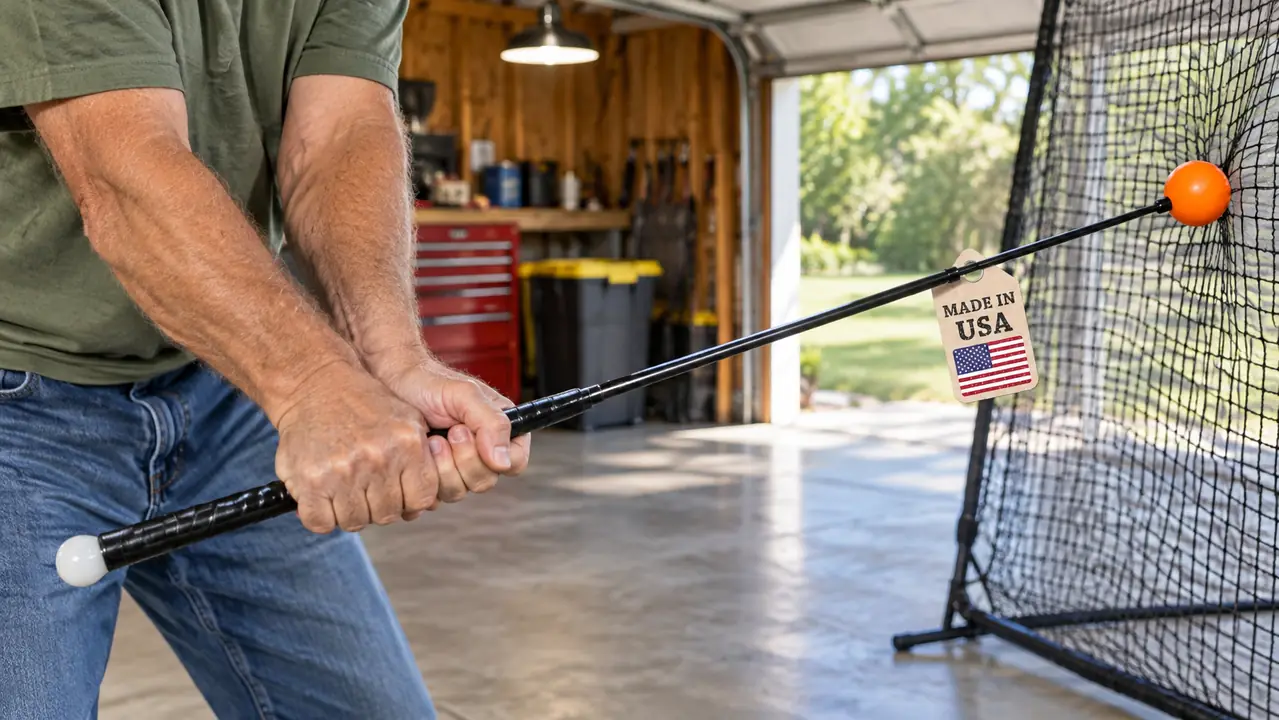
My setup is a hitting net and a mat in a detached garage, plus a short strip of backyard for chipping and putting. I keep the Orange Whip leaning against the wall next to the net. Four or five mornings a week I pick it up and make ten slow swings before I touch a real club. On Saturday I take it to the public range and swing it a dozen times before the first ball. Before a league round it gets maybe eight swings on the practice tee while I am waiting for the group ahead of me.
That is the whole routine. No video, no mirror, no launch monitor, no printed schedule taped to the wall. Ten swings, slow, paying attention to where the weight is, then a real club. The first two weeks I did it wrong. I went at it like I was trying to hit one 300 yards, the shaft whipped and wobbled, and I felt like a grown man holding a wet noodle. Then I slowed down, and the thing started working.
Total time per session is under two minutes. That matters more than it sounds like it should. I have bought training aids that came with a twenty-minute protocol and a progress chart. Those are in a bucket in the corner of the garage, behind the snowblower. This one survives because it fits into the two minutes I actually have on a Tuesday morning in February.
What 47 Inches and 1.9 Pounds Actually Do
The Orange Whip is 47 inches long, which is longer than anything in my bag, and it weighs 1.9 pounds. The shaft is graphite and it is deliberately flexible, and there is real weight in the head. Those facts together are the entire product. There is no adjustment, no setting, no sensor, no readout. It is a long stick with weight in the right place and a hinge where your hands are not.
Here is what that does. When you swing something long and flexible from the top with your hands, the shaft bends, the weight lags behind, and you can feel the sequence arrive out of order. You cannot muscle it straight. When your hips lead and your arms follow, the shaft loads and unloads on time and the whole move feels quiet. There is nothing to read and nothing to check. Your hands tell you whether you got it right before you finish the follow-through.
People call it a feedback tool, and that is accurate, but I would put it more plainly. It is a lie detector. My hands have been lying to me about my transition for 25 years and this thing caught them in the first week. The listing describes it as coordinating rhythm between your arms, upper body and lower body. That is marketing language, but it is marketing language for a real thing. My arms and my body have been running on two different clocks for most of my golfing life. This put them on the same clock.
The Tempo Change I Noticed by Week Three
Somewhere in the third week, my backswing got shorter without me deciding to shorten it. That is not a thing I have ever managed on purpose. For years I have taken the club back until it feels like the head is behind my right heel, then rushed everything to get back to the ball. With the Orange Whip, going back that far felt so clearly out of balance that I stopped doing it, and it happened on its own.
The result on the course was not distance. If anything I lost a few yards the first month while the new move settled in and I stopped flipping at the ball to save it. What I got was a ball that started closer to where I aimed it. My miss for 20 years has been a low hook that shows up when I get quick, and it showed up less. My league partners noticed before I did, which is the most honest feedback a 14 handicap can get.
I will not tell you it lowered my handicap, because it has not, at least not yet. A 14 who practices ten slow swings in a garage is still a 14. What changed is the number of truly bad swings in a round. Fewer of them means fewer holes where I am standing in the trees deciding between a hero shot and a chip out sideways. That is worth more to me than five extra yards off the tee, and I did not expect to be saying that.
What It Did for My Back, and What It Didn't
I have a lower back that tightens after a range session or 18 holes, worst the next morning. My doctor looked at it years ago and called it ordinary muscle strain and stiffness, nothing surgical. I am not going to tell you the Orange Whip treats that, because it does not, and I would not trust anyone selling a golf club who said it did.
What it does is give me a way to warm up that is not a sudden jolt. Eight slow swings with a 1.9 pound trainer gets blood into the places that complain before I ask them to hit a driver. On mornings when I skip it and go straight to a real club, I feel it on the second tee. That is a warm-up benefit, not a cure, and the difference matters.
There is a catch, and it is worth saying out loud. If I swing it hard and cold, it hurts. The length adds leverage and the weight is real, and a stiff 57-year-old back that goes at this thing like a driver will feel it that night. Slow swings only. If you cannot make a slow swing without pain, this is not the tool that fixes that, and you should talk to somebody who knows more about backs than I do.
The Boring Details That Hold Up
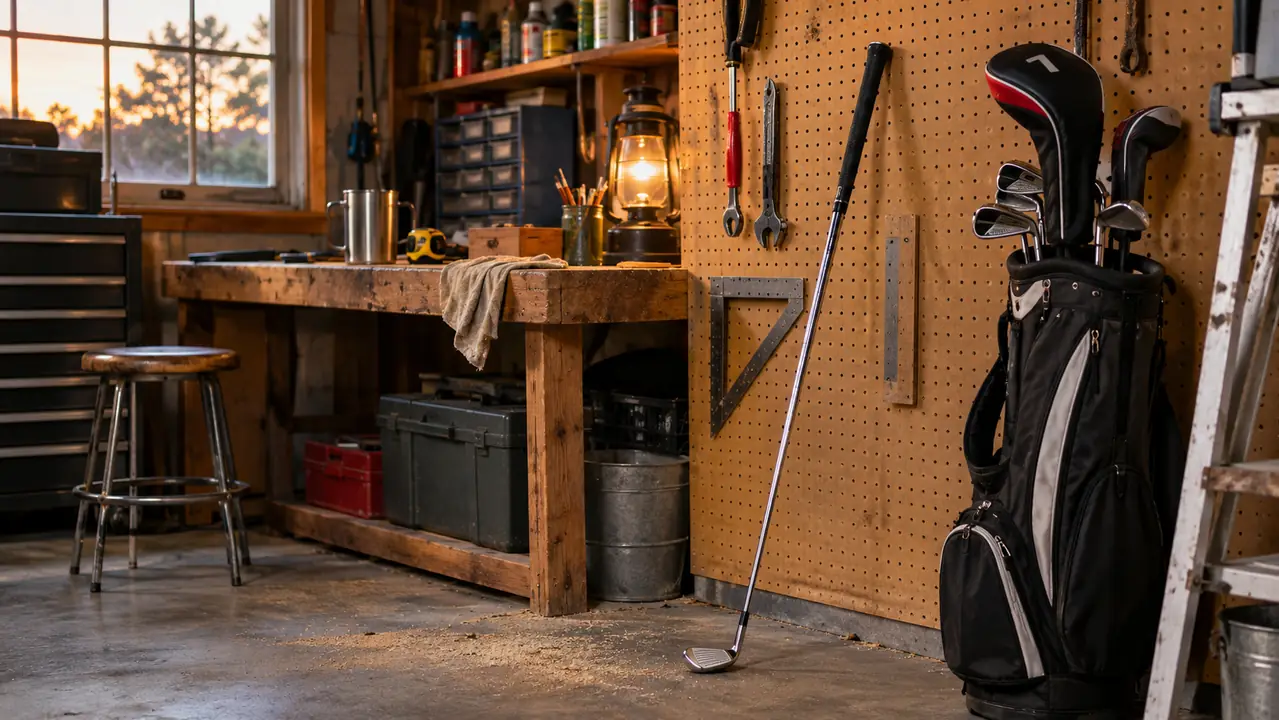
The shaft is graphite, the grip is synthetic rubber in a regular men's size, and it is ambidextrous, which means the left-handed guys in my league can use the same tool without hunting for a mirror version. It is made in the USA and carries a 2-year warranty. The listed dimensions are 48 inches long by 4 inches wide by 4 inches high for the package, with the club itself at 47 inches.
Mine has lived in an unheated garage through an Ohio winter and a humid summer, gets dropped on a mat, and leans against a wall next to a can of primer. The grip is still tight and the shaft has not taken a set. The grip has gone from tacky to slightly less tacky with range dirt on it, which is what grips do, and I will replace it eventually.
One note on the same shelf: there are copies of this thing now. The listing says patented and made in the USA, and the copies are neither. I swung a friend's copy once and the flex felt different, closer to a stiff shaft with a weight taped to the end, and it gave me none of the feedback I bought mine for. If you are going to buy one, buy the Orange Whip.
Where It Falls Short
It is not portable. At 47 inches it does not fit a normal travel bag without pulling the head, and it does not break down. Mine stays home when I travel for work, which means the routine breaks too, and I feel it for a week after I get back.
It also gives you nothing to measure. No numbers, no readout, no feedback beyond what your hands feel. If you are the kind of golfer who needs a graph to stay interested in practice, this will not hold you past the first month. And because it is long, a low ceiling or a tight backyard limits your swing. I have clipped a rafter light twice, and my garage ceiling is 10 feet.
The last point is the honest one. It costs more than a broomstick with a wrench taped to the end, and the broomstick will teach you some of the same lesson. What your money buys is the flexible graphite shaft, which is the one part no homemade version reproduces, and it happens to be the part that actually teaches sequencing. That is a fair trade in my book, but it is a trade, and you should know it going in.
What I Liked
- Makes bad swing sequencing obvious within a handful of swings
- 47 inch length and 1.9 pound weight force a slower, more balanced backswing
- Doubles as a five-minute warm-up before a league round or range session
- Ambidextrous, so left-handed players can use the same tool
- Graphite shaft and synthetic rubber grip have survived a year of garage storage
- 2-year warranty and made in the USA
Where It Falls Short
- Does not break down and will not fit a standard travel bag
- No numbers or readout, only what your hands feel
- Swinging it hard or cold will flare up a sore back
- Needs ceiling height for a full swing
- Costs more than a homemade alternative that teaches part of the lesson
I hit 11 of 14 fairways in a league round in May. Same swing, same league, same 14 handicap. The only thing different that month was ten slow swings in the garage before I left the house.
Who This Is For
This is for the golfer who already has a swing and wants it to repeat. If you fight a quick transition, an overlong backswing, or a lower body that shows up late, the Orange Whip is the most direct feedback I have found for that specific problem. It suits players who practice in short bursts at home, who want a warm-up that doubles as a lesson, and who are fine with that lesson arriving by feel instead of on a screen. It also suits older players with a back that tightens up, provided they use it as a slow warm-up and not as a strength test.
Who Should Skip It
Complete beginners should skip it. Without a basic idea of how a golf swing sequences, all this thing delivers is wobble, and you will conclude it is broken when it is your hands. Take three lessons first and come back. Skip it too if you have an active back injury or cannot make a slow swing without pain, because a 47 inch weighted trainer is not a rehab tool and I would not pretend otherwise. Skip it if your only practice space has a low ceiling. And if you want data to look at, buy something that measures things. If you want a better feel for tempo, this is the one I keep by the net.
Ten Slow Swings Before Your Next Round
That is the whole method. 47 inches, 1.9 pounds, flexible graphite shaft, synthetic rubber grip, ambidextrous, 2-year warranty. Mine is leaning against the garage wall right now.
Amazon Check Today's Price on Amazon →