

I bought the Seticek alignment sticks for a boring reason. Every spring I would dig two old driveway markers out of the garage, jam them into the ground at the range, and spend the first ten minutes of a Saturday session building a setup instead of hitting shots. Then I would leave them there and do the whole thing again the following week. This pair folds down to 17 inches, so it lives in the side pocket of my golf bag instead of leaning against the wall by the shop door. That is the entire pitch, and it is a good one.
Now the part that is not printed on the package. Alignment sticks do not fix a golf swing. They show you where your swing already is. I have played a Thursday evening league for twenty five years and I carry about a 14 handicap, and I still set up aimed right of where I believed I was aimed. A stick on the ground proved that in about ninety seconds. It did not then correct it. Correcting it took a season of short, slow sessions on a mat in my garage, and through all of it the Seticek sticks were the mirror, not the teacher. If you are buying the first kind of thing, save your money. If you want the second, here is what I found after a full season with them.
The Quick Verdict
A well made, genuinely portable practice tool that tells you the truth about your setup and nothing else. Worth it if you will use it twice a week. Not a fix.
Amazon Check Today's Price →Two sticks, 17 inches folded, and a setup you can actually check
48 inches open, 91 grams each, folds into a bag pocket and stays there. That is the whole reason these get used instead of the markers in your garage.
Amazon Check Today's Price on Amazon →How I've Used It
My practice setup is not fancy. I have a hitting net and a mat in the detached garage, a short strip of backyard for chipping and putting, and a public range most Saturday mornings. The Seticek pair has been in the bag since spring, and I use it three ways, none of them clever.
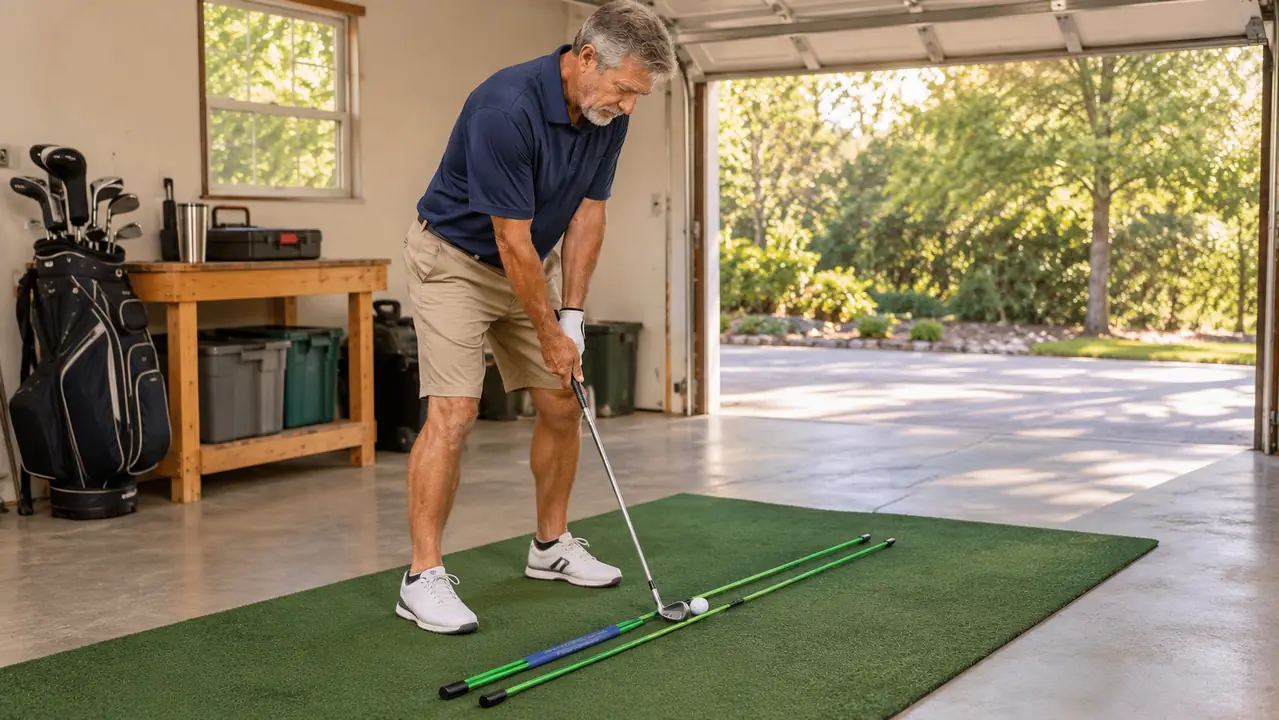
The first is the stance station. One stick goes on the ground along my ball line, and the second goes parallel to it just outside the ball. The listing describes this as keeping the shoulders, hips and feet aligned, and that is exactly what it does. You stand there, you look down, and you either match the sticks or you do not. There is no arguing with it. The first time I did it I was aimed a good eight inches right of where I believed I was, and that belief had survived years of league play without ever being tested. I did not trust the eight inches either, so I put a tee in the ground where the outside stick said my feet should sit and a second tee where I had been aiming for years. The gap between the two tees was about the width of my hand. I hit ten balls from the corrected line and every one of them started right of the old target, which told me my aim had been a compensation rather than an aim. That is an uncomfortable thing to learn at fifty seven.
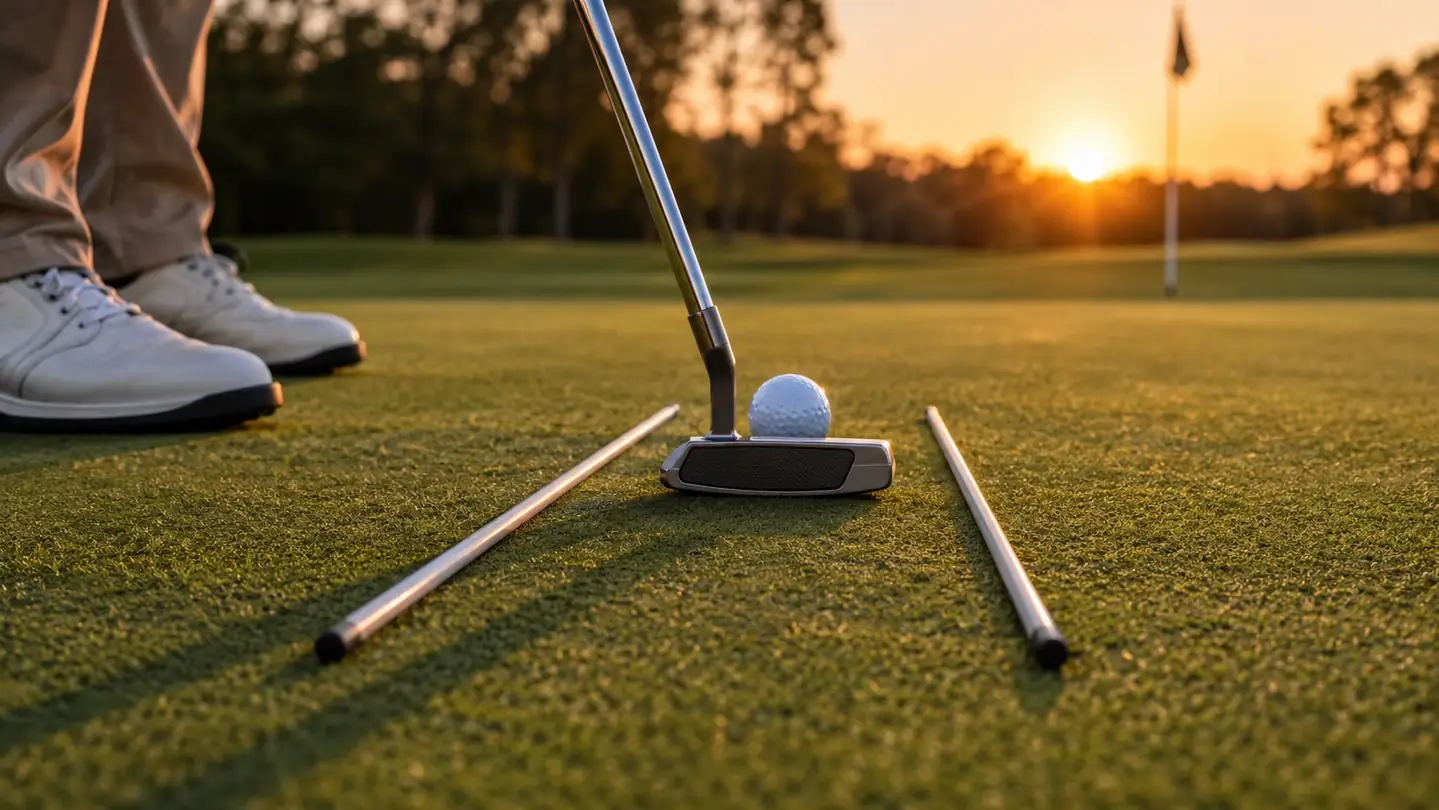
The second is putting. Two sticks laid flat make a rail or a gate, and a gate is a brutal and honest teacher of face angle. Mine sits about two inches wider than the putter head, in the backyard. If I fan the face open, the stick gets hit and I hear it. I do twenty of these before I do anything else, which takes four minutes, and it has done more for my short putting than every video I have watched on the subject.
The third use was not in the plan. When my lower back starts tightening up on the mat, I lay the stick down and reset my posture before the next swing instead of grinding through twenty more balls in the same bad position. That is not the stick doing anything to my back. That is the stick making me stop, which is the thing I was never good at doing on my own.
Saturday mornings at the range are where it earns its keep. I get there early, build the station before the stalls fill, and hit maybe forty balls. Forty, not a hundred. I check my feet against the stick for the first ten, then I stop looking down and just swing, then I check again for the last ten. That last check is the one that matters. It is easy to start on the line and drift off it by ball thirty, and that drift was quietly wrecking my league rounds without me noticing it.
What Actually Works
The parallel line setup is the most useful thing here, and it is the part most people get wrong. The stick at your feet does not point at your target. It points parallel to your target line, and the second stick sits parallel to that. If you aim the stick directly at the flag, you have built a station that teaches you to aim left of your actual target, and you will spend a month hitting pushes and blaming your swing. Set the sticks on the line your ball starts on, not the line you want it to finish on. That one correction was worth more to me than the sticks themselves. I learned it the hard way on a Saturday in May. I had the stick pointed straight at the flag and hit about thirty balls that all started left and drew back toward the pin, and I spent the drive home convinced my swing had changed. It had not. The station was teaching me to aim left. I reset the sticks parallel to the target line the next morning, hit ten balls, and the pull was gone. Nothing about my swing had changed in twelve hours. Only the reference had.
Two sticks in the pack is also the right number, and I would not buy a single. One stick is a drill. Two sticks is a station you can stand in and check three things at once. I have watched guys at the range lay one stick down, hit ten balls, and pick it up, and they got almost nothing out of it. The value is in the second stick setting the outside boundary so you can see your feet drift, because feet drift more than anybody believes.
The shoulders check is the one I underrated. Hold a stick across your chest and turn, and you can feel whether the shoulders are turning under the chin or sliding out toward the ball. I do not do this every session. I do it when the ball starts going right, because nine times out of ten my shoulders have crept open at address again, and one rehearsal with the stick across my chest shows it faster than ten swings.
And the folding is the whole reason these beat a driveway marker from the hardware store. 48 inches fully open, 17 inches folded, 91 grams each. That is light enough that you will not notice it in the bag and short enough that it fits in the same pocket as your spare glove. The best training aid is the one that is with you. The Seticek pair has been to the range every Saturday since spring, which is more than I can say for the three swing trainers I bought before it and left in the garage.
What Does Not Work
If you cannot see your swing, a pair of sticks will not tell you what is wrong with it. It tells you where you are aimed. If your problem is coming over the top or flipping through impact, the sticks will confirm the setup that goes with it and nothing more. I know because I spent about six weeks setting up perfectly and hitting the same weak cut I have hit since my thirties. The sticks were right. The swing was wrong. It took a phone propped against my bag to see why, and I would have saved myself a month by doing that first. The specific version: I had a session in early June where I laid the station perfectly, hit twenty balls, and every single one went right with a flat, weak flight. I checked the feet, checked the shoulders, checked the ball position, and the sticks all said I was fine. They were right. I was swinging the club out and across the ball, and a stick on the ground has no way to see that. Ten minutes of video on my phone showed it in one swing.
They also will not do a thing for your back on their own, and I want to be blunt about that because this is a category where a lot of products lean on the idea. My lower back tightens after a range session and it is worse the next morning. That has been true for years and it is still true. The Seticek sticks are not a treatment and they are not sold as one. What changed for me is that I now hit forty balls in a session instead of a hundred, with a reset in between, and I stop when the posture goes. The sticks helped me notice the posture going. That is the honest version of the story, and it is a smaller claim than the one you will read elsewhere.
Two things about the hardware. Glass fiber is tough and light, but it does not like being bent or jammed into hard ground. Driveway markers crack and splinter at the tip and these are the same family of material, so treat them like a measuring tool and not a tent stake. And there is no warranty listed on the product at all, so if one goes, it goes. At this end of the market that is not a scandal, but you should know it going in rather than finding out.
The stick did not fix my aim. It proved I was aimed wrong, which is a less satisfying thing to buy and a far more useful thing to own.
The Details Nobody Mentions
The 48 inch length is fixed, no adjustment, and that cuts both ways. On a flat range mat, which is what most of us practice on, it is exactly right for a standard setup. Take it onto a tee box with any slope to it and the stick will rock, sit proud of the turf, and cost you more time fiddling than swinging. I use mine on the mat and on the flat part of the backyard, and nowhere else. If your home course is all sidehill lies, this is a tool for the range, not the course.
The other thing nobody says is that these are a reference tool, not a feedback tool. Ball flight is your feedback. The sticks tell you whether the input was repeatable. Lay them down, hit five balls, and if they all start on the same line, the station is doing its job. If the strike pattern wanders all over the mat, you have found your actual problem, and it is not alignment, and no amount of arranging sticks will change that. That is not a knock on the product. It is what the product is for. Here is how it plays out in a real session. Forty balls, station set, and I mark where the divots go with my eye. If the divots fan left, the aim was left and I was not paying attention. If they are all inside a two inch circle and the ball still cuts, the aim is fine and the face is not. That distinction is the whole game, and it comes from looking at the ground, not from the equipment.
On the practical side, the package weight is about 0.26 kg for the pair and each stick is 91 grams, so there is no excuse not to bring them, which is also the thing that will expose you. If you own these and your aim is still off, it is the setup you are not checking, not the equipment letting you down. That is uncomfortable and it is the reason these work.
What I Liked
- Folds to 17 inches, so it actually travels instead of leaning in the garage
- 91 grams each, light enough that you forget it is in the bag
- Two sticks make a usable station, not just a single-line drill
- Glass fiber holds up to normal range and mat use
- No batteries, no settings, nothing to charge or calibrate
Where It Falls Short
- No warranty listed on the product
- Fixed 48 inch length with no adjustment for slope or stance
- Will not diagnose a swing fault, only show where you are aimed
- Glass fiber can splinter at the tip if you jam it into hard ground
- Does nothing for your back by itself, despite what the category implies
Who This Is For
This is for the golfer who already suspects the setup is the problem and wants proof. If you have been playing long enough that your swing is roughly what it is going to be, and your miss is consistent, the cheap gain left on the table is aim and posture. That is precisely what two sticks on the ground will show you in one session. It suits the player who practices in short blocks at home or at a range and wants something that rides in the bag without being a project.
It also suits anyone over 45 with a back that talks to them after a session. Not because the sticks treat anything, but because they give you a reason to stop and reset instead of hitting ball ninety in a collapsed posture. I hit fewer balls now than I did five years ago and I get more out of each one, and that trade only happened once I had something on the ground forcing me to look.
Who Should Skip It
Skip it if you want a device that produces a swing change for you. This is two glass fiber rods. It has no opinion, no feedback loop, and no way to tell you that you early extended. Buy a lesson instead, or prop your phone up and film yourself, and use that information first. The sticks are a poor substitute for knowing what your swing is doing.
Also skip it if you only practice on a course and never on a flat mat or a range. A 48 inch stick on a sidehill tee box is more trouble than it is worth, and it will end up in the garage next to the driveway markers you already own. And if you are shopping for something to help your back, be clear that this is not that product and was never marketed as one. It is a setup check that happens to encourage you to slow down.
If you are going to check your setup, check it with something that rides in the bag
Two 48 inch sticks, 17 inches folded, 91 grams each. The pair I have used every Saturday since spring. Today's price is on the listing.
Amazon Check Today's Price on Amazon →