

The thing nobody tells you about the Orange Whip is that it will embarrass you in your own garage. Not on the first swing. On the third, when the shaft loads and the weighted end keeps traveling after your hands have already stopped, and you understand that for 25 years your arms have been doing a job the club should have been doing for them.
I am 57, I own a small sign shop in central Ohio, and I have played a Thursday evening league for a quarter of a century. My handicap floats around 14 and has floated there since the first Bush administration. I bought the Orange Whip the way most men my age buy one: after a Saturday range session that left my lower back tight enough that I felt it getting out of the truck the next morning. This is the review I wish someone had handed me, including the parts that are not flattering to the club.
The Quick Verdict
A real tempo and mobility tool for an ordinary golfer with a stiff back. It will not fix a slice on its own, and the first ten days will humble you.
Amazon Check Today's Price →The Training Club That Made My Practice Swing Slower, Not Longer
47 inches, 1.9 pounds, and a patented flexible shaft that forces your hands to wait for your body. That is the whole trick, and it is a good one.
Amazon Check Today's Price on Amazon →How I've Used It, Week by Week
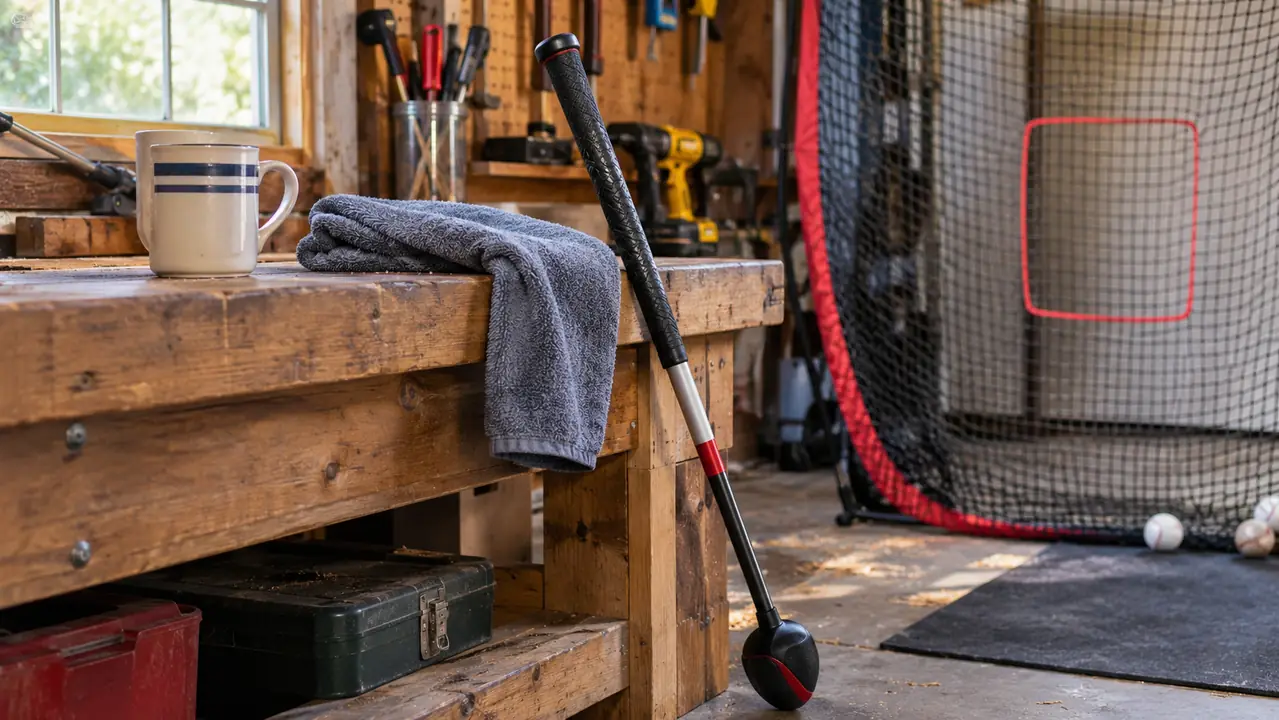
My setup is a hitting net and a mat in a detached garage, plus a strip of backyard for chipping and putting. I do not own a launch monitor and I am not going to build a simulator in a building that also holds a table saw. The Orange Whip leans against the bench next to the net, and I use it three ways: ten slow swings before I hit balls, five swings after, and a short set on weeknights when my back is complaining and I am not going to hit anything at all.
The pre-range routine is the one that stuck. Ten swings, both sides, because the club is ambidextrous and the grip works either direction. Left-handed swings felt ridiculous for about a week, then stopped feeling ridiculous, which is the first honest thing I can tell you about flexibility work: the side you never use is the side that needed it.
The post-range set is shorter. Five swings, hunting for the tempo I want rather than the tempo I actually have. By the twentieth ball at the range I can get quick and armsy with the best of them, and five swings with a 47-inch trainer that refuses to be rushed resets something in my head. It is not a permanent fix and it is not a transformation. It is a reminder you can carry to the first tee.
The weeknight set is the one I did not expect to matter. Twenty swings in the garage with the door down, no ball, no net, nothing to hit. It takes four minutes. That is the entire reason this club earned a spot against the wall instead of a spot in the bin of things I tried once, which currently holds a putting arc, a weighted donut and a training grip I never installed.
I started on a Tuesday in the second week of March, the week the range near me finally opened after a winter that would not let go. My plan was fifteen swings a day. I lasted four days. Fifteen slow swings with a weighted club is more work than it sounds, and my forearms were sore in a way that had nothing to do with my lower back. Ten is the number I have kept since. Ten swings takes about ninety seconds, which means I can do it in work boots with a sign order due at four o'clock and no excuse available. The mat slid on the concrete that first week, so I put a scrap of rubber under it. That is the entire setup this requires.
The other thing I learned early: do not do this set tired. Twenty swings after a full day on my feet at the shop is twenty swings where I cheat the turn and let my arms drag the club through. A tired swing with a trainer teaches you a tired swing. I moved the set to the morning before the shop opens and the quality went up immediately. Four minutes at 6:40 in the morning, coffee going, door up. That is the habit now, and the habit is most of what you are buying here.

The First Ten Days Are Humbling, and That Is the Point
Every write-up of a tempo trainer says it teaches you to swing in sequence. True, and useless. Here is what actually happens. You take your normal swing speed, the shaft bends, and the weighted end lags behind your hands. Your instinct is to speed up to catch it. When you do, the whole thing goes sideways and you feel a small pull across the front of your shoulder that tells you your arms have been running the show since roughly 1998.
Days one through four, I swung it badly. Days five through ten, I swung it slowly. Somewhere around day eleven I made a swing where the club felt light at the top and heavy at the bottom, and the ball came off the net and went into the neighbor's yard. The lesson was not the ball. The lesson was the feel, and I have been chasing that feel on the course ever since.
Day six is the one I remember. I was swinging in the garage with the door down, and on the through-swing the weighted end caught the door track with a clang loud enough that my neighbor looked over from his driveway. I had been giving myself a chipping swing's worth of room, not a driver's worth. Measure it before you start: 47 inches of club plus your arms plus a full turn means you want eight feet of clear space in every direction, and a one-car garage bay gives you that only if the car is out and the ladder is hung back up on the wall.
Compare that to the weighted donut sitting in my bin. A donut slipped over a regular club just makes a regular club heavier, so you swing it the same way you swing everything else, only slower and with more strain in your hands. The flexible shaft is the whole difference. It does not let you get away with the same move. That is exactly why the first week feels bad. A training aid that never makes you feel bad is not teaching you a thing.
This is also why I think a lot of people write the club off in week one. It makes a grown man with a 14 handicap feel like a beginner, and nobody enjoys that. If you can tolerate ten days of feeling like a beginner, you get something worth keeping. If you cannot, this becomes another item in the garage, and it is a fairly expensive item to leave in the garage.
Rhythm Is the Real Product. Distance Is Marketing.
You will read claims about added distance. Treat them with suspicion. I did not gain a yard and I doubt I lost one. What I gained was a repeatable way to start the downswing, which shows up as fewer of the fat, stuck, shoulders-first shots that ruin a decent round.
The honest way to measure this is not the scorecard, because the scorecard is noisy and my league has a lot of wind. The honest measure is the number of swings per round where I finish in balance, holding the pose, able to watch the ball. I went from maybe six or seven of those to something closer to twelve. Same handicap. Better Thursday evenings.
Here is a concrete one from a league night in May. Par four, into a wind that had been in my face all evening, and I had made a mess of the two previous holes by getting quick with my hands. Standing over the ball I thought about the trainer and the one thing it drills into you: the hands wait. I made a slower, fuller turn, the club caught up on its own, and the ball came off the middle of the face for the only time that nine. I did not make the putt. I did finish the round without the stuck, shoulders-first swipe that has cost me a ball a round for years.
Two shots like that a round is most of the difference between a 14 and a 12, and I am not going to claim the club handed me that. It gave me a feel I could recall standing on a tee, which is a smaller and more honest thing than a distance claim.
That gap matters at my level. A 14 handicap is not losing strokes from a lack of clubhead speed. He is losing strokes because two or three times a round he makes a swing where his body and his hands disagree about the plan, and the ball goes somewhere nobody chose. The Orange Whip is a tool aimed at that specific argument, and it is the best one I have tried that fits in a garage and does not need a battery.
What It Did for My Back, and What It Did Not
My back story is boring and I would like to keep it that way. Years ago a doctor told me it was ordinary muscle strain and stiffness, nothing surgical. It tightens after a range session or 18 holes and it is at its worst the next morning. I am not going to sit here and tell you a golf club treats anything, because it does not.
What I will tell you is what changed in the routine. Ten slow, full swings with a 1.9-pound trainer before I hit a ball is a warm-up I would never do with a 7 iron, because swinging a 7 iron ten times slowly feels like wasting range balls. The trainer makes the warm-up feel like practice, so I actually do it. The result is that I walk into the first ball looser than I used to. Whether that is the club or simply the fact that I am finally warming up like a man my age should, I cannot prove, and I will not pretend otherwise.
Here is the honest version, because this is where I think people fool themselves. The morning after my first full range session with the new warm-up, my back was tight in exactly the same place it has always been tight. Nothing changed in week one. What changed by week four was the size of the tightness after a session, not the fact of it. On a scale of one to ten, where a bad Sunday morning used to be a six, it is now more often a four. That is a real difference in how a Thursday evening feels, and it is not a cure for anything.
The test I used was boring and reliable. Every Sunday morning I would bend over and reach toward my knees, then stand up and note whether it hurt. No change for three weeks. Some change after five. I am well aware that a man doing daily movement work is going to loosen up regardless of which club he swings, and I will not pretend to know which part did the work.
One thing I would flag plainly. This is not a stretching device and it is not a medical device. If your back is worse than ordinary stiffness, talk to your doctor before you start whipping a 47-inch club around a concrete floor. I mean that without any salesmanship attached.
Build, Size, and the Small Annoyances
The specs are what they are: 47 inches long, 1.9 pounds, graphite shaft, synthetic rubber grip in a regular men's size, ambidextrous, shipped as one piece measuring 48 by 4 by 4 inches. It is made in the USA and it carries a 2-year warranty. It feels like a tool rather than a toy. The grip has survived a full season of garage use and one stretch of very hot weather when the shop was 95 degrees inside.
The annoyance is the length. A 47-inch club does not fit in a normal Sunday bag and it does not travel well. Mine stays home. If you want a trainer to loosen up on the range before a round, you are carrying it loose or leaving it in the truck, and leaving any club in a hot truck is a poor idea.
The second annoyance is clearance. The weighted end is heavy enough that you cannot swing it indoors without checking the ceiling. I have clipped the garage door track twice. That is on me, but know it going in and give yourself a full swing's worth of room, not a chipping swing's worth.
The honest measure is not the scorecard. It is the number of swings per round where I finish in balance and can watch the ball go.
What I Liked
- Teaches sequence by feel rather than by instruction, which is how a 14 handicap actually learns
- Ambidextrous, so the side of your body you never use gets the same work
- 1.9 pounds and a flexible shaft turn a warm-up into something you will actually do
- Solid build and a 2-year warranty behind it
- Needs nothing but floor space, no balls and no launch monitor
Where It Falls Short
- 47 inches makes it awkward to store and impractical to travel with
- The first ten days feel like a step backward
- It will not fix a slice, a grip problem or a setup problem
- You need real ceiling clearance to swing it indoors
Who This Is For
This is for the golfer who already plays, roughly once a week, whose swing works most of the time and falls apart two or three times a round. You want a way to work on tempo at home without a lesson package or a monitor. You have a back that gets stiff after a session and you would like a warm-up you will genuinely perform instead of skipping. You have a garage, a carport or a patch of yard and about four spare minutes a day.
It is also decent first aid for the golfer coming back from a layoff. The club is forgiving of a slow swing and merciless with a fast one, which is the right posture for someone rebuilding. If you want more on how it holds up over a full season, there is a longer-term look at this club on the site, and a head-to-head against the SKLZ Gold Flex if you are weighing the two.
Who Should Skip It
Skip it if you are a low single-digit player with a grooved sequence. You already own the feel this club is trying to teach and you will find it slow. Skip it if your problem is a slice that comes from an open face, because this club does nothing for the clubface and you need a lesson, not a trainer. Skip it if you want feedback. It gives you nothing but feel, and if you cannot read feel, you are swinging a stick.
And skip it if you are honest with yourself about not using it. It is a 47-inch club leaning against a wall. It works because you pick it up four times a week, not because it is in the garage. That is the whole truth about every training aid ever sold, and I include this one in the statement.
If Your Practice Swing Is Faster Than Your Playing Swing, Start Here
Ten slow swings before you hit balls, both sides, four minutes in the garage. Backed by a 2-year warranty and about 2,600 reviews that say roughly what I just said.
Amazon Check Today's Price on Amazon →