

The first thing nobody tells you about a back brace is that it does not fix anything. I bought the MUELLER Sports Medicine Adjustable Back Brace half expecting a repair and got something closer to a good helper. I am 57, I own a small sign shop in central Ohio, and I have played a Thursday evening league for 25 years at roughly a 14 handicap. My lower back tightens up after a range session, and the morning after 18 holes has been the worst part of my week for a while now. My doctor looked at it years ago and called it ordinary muscle strain and stiffness, nothing surgical. So when the stiffness started cutting Saturday morning range sessions short, I went looking for something I could put on, take off, and not think about again. That is the honest frame for this review. What the brace does, what it does not, and the three things I would change if MUELLER asked me.
I had already been through the cheap options. A soft sleeve from a drugstore that rolled itself into a rope the moment I bent over. A lifting belt I already owned, which is built to hold a braced position under a load, not to sit at a desk quoting a job and then walk 18 holes. A lumbar cushion in the truck that helped the drive to the course and nothing after it. None of those were terrible. They just missed the one job I needed done, which was to give my lower back something to lean against while I was upright and moving. This brace is the first one that stayed where I put it. Low bar. It cleared it. The rest of this is the detail behind that sentence, including the parts I do not love.
The Quick Verdict
A firm, adjustable brace that gives a complaining lower back something to brace against during rounds and shop days. It did not fix the stiffness and it will not fix yours. It made the bad mornings less frequent, which is what I was actually after.
Amazon Check Today's Price →It will not fix your back. It will help you finish the round.
Eight steel springs, adjustable straps, a one year warranty, and a brand that has been in sports medicine for over 60 years. Measure your waist before you order, then look at today's price.
Amazon Check Today's Price on Amazon →How I've Used It
Three ways. Shop days first, standing at the vinyl cutter and the laminator for six or seven hours with a lot of bending and lifting. The Saturday range session second, usually 60 to 80 balls off a mat. The Thursday league round third, walking, which is the one I actually cared about. I started at an hour at a time because anything worn longer than that gets clammy and starts to irritate. The first real run was a Tuesday in the shop, three hours of weeding small vinyl lettering on a sign order, and I had it on from just after lunch until about four. That afternoon told me most of what I needed to know. The stiffness was doing something the soft sleeve never did, and four hours was my limit before the heat built up under it. Over about six weeks I worked up to a full nine holes and then a full 18, and I now keep it in the golf bag rather than in a drawer, which tells you what you need to know about how often it gets used.
The material is a neoprene blend with nylon and polyester, plus rubber and stainless steel in the hardware, and the whole brace is listed at about 0.4 kg. That weight is not nothing. You know it is on you. But it sits close enough to the body that it did not change how I set up over the ball, and it did not catch on my shirt when I turned through. That last part mattered more than I expected, because the drugstore sleeve I tried before this one twisted out of position every single time I made a swing.
The compression is the whole point. Not heat, not any kind of support magic, just the feeling that something is holding the lower back in a slightly better position than it would hold itself. On days when my back was already angry, that feeling was worth the thirty seconds it takes to put the thing on. On days when it was fine, I left it in the bag. That rhythm has held for six weeks and I do not expect it to change. What has changed is how often the bad mornings show up, and that is the only claim I am willing to make.
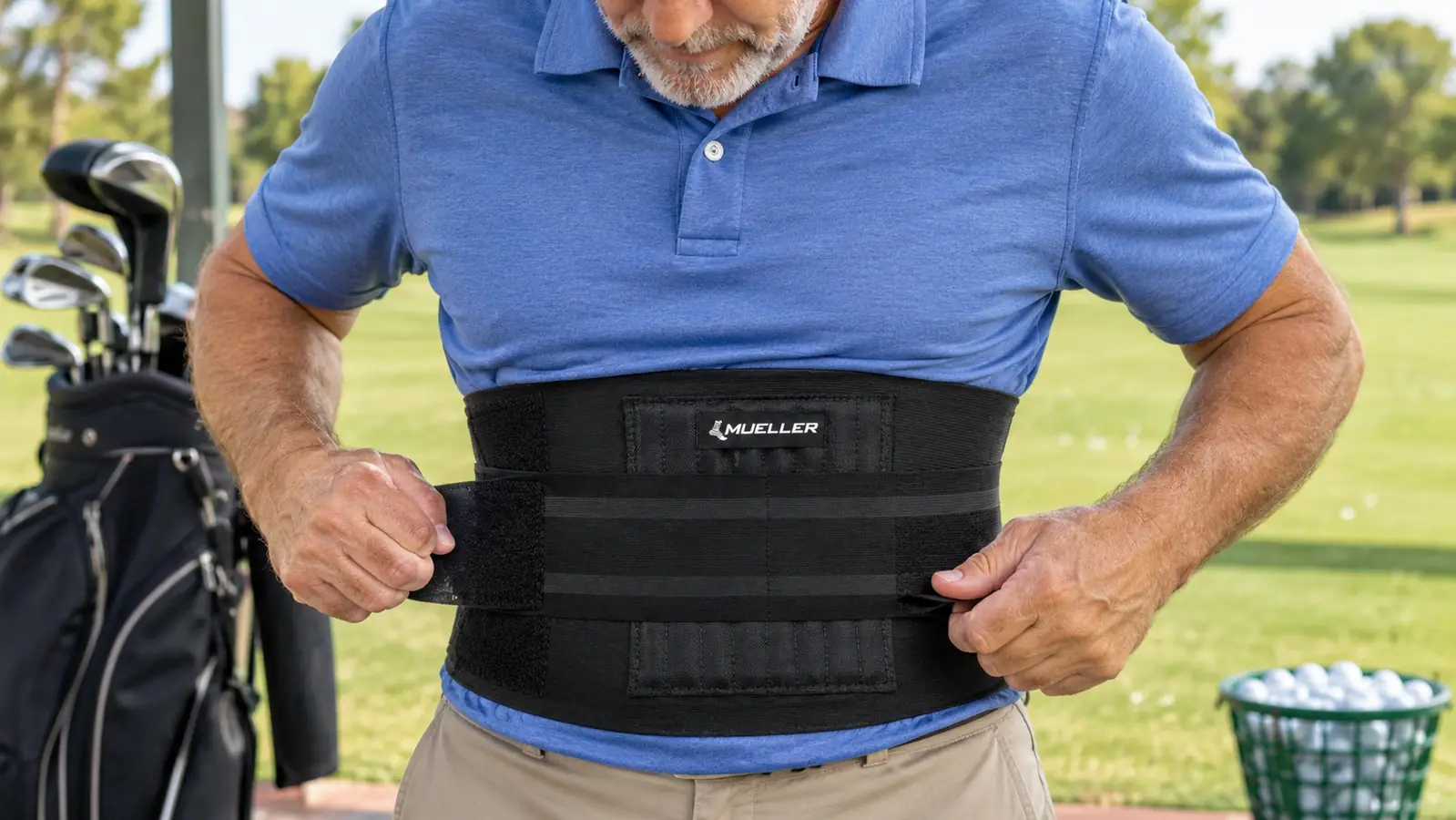
What the Eight Steel Springs Actually Do
The listing says eight steel springs deliver firm, targeted, supportive compression, and here is the plain translation. Those springs live in the back panel and stiffen it, so the whole brace resists folding over when you hinge forward. You feel them most when you bend. They do not move on their own, they do not massage, and they do not shape themselves to your spine. What they do is turn a soft wrap into a stiff panel, and that is the difference between a belt and a brace. If you have only ever worn a soft lumbar sleeve, this is the part that will surprise you.
The adjustability is real, not marketing. You set how much compression you get by pulling the straps, and it is meant to be measured around the widest part of your waist rather than your trouser size. That is the single most useful instruction on the whole product page and it is the one most people skip. I measured 38 inches, went with the One Size, and had room to tighten for a round or loosen for an afternoon at the desk. Since the fit is adjustable rather than fixed, the same brace can be a firm support on the course and a mild one in the shop.
The product page lists a one year warranty. I have not had to use it, so I cannot tell you how that process goes. What I can tell you is that after a couple of months of regular use the stitching and the strap ends are still intact. The cheaper sleeve I tried before this one frayed at the edge in about three weeks. That comparison is not scientific, but it is the one I have.
The Sizing Question Nobody Warns You About
There are two sizes. Small fits a waist of 22 to 30 inches, and the One Size fits 28 to 50 inches. Read those numbers again, because they are doing something unusual. The One Size covers an enormous range, which means one brace has to work on somebody at 28 inches and somebody at 50. It manages that with strap length and overlap, and on the smaller end of the range you will be wrapping a fair amount of strap around yourself to get any compression at all.
My advice if you are anywhere near a boundary is to measure twice and be honest about where you carry your weight. A brace that is too loose slides up under the ribs when you bend. A brace that is too tight is miserable by the third hole. The measurement goes around the widest part of the waist, level with the navel, not where your trousers sit. I got that wrong the first time and ended up with a number two inches off, which is exactly the kind of mistake that turns a decent brace into a bad purchase. Use a soft tailor's tape and do it in the morning before you eat, because that is when the number is honest. Then do it again the next day and see whether you get the same answer. Four minutes in a bathroom with a tape measure is cheaper than a return.
The Golf Part, Honestly
I am not going to sit here and tell you this brace added yards or straightened out my fade. It did neither. What it did was let me get through a bucket of 70 balls without the sharp little catch on the left side of my lower back that used to show up around ball 40. That catch was the thing ending range sessions early. Ending range sessions early is how a 14 handicap stays a 14 handicap for a decade, so removing it counts for something even though it shows up nowhere on a scorecard. The clearest test was a humid Thursday league night in the middle of those six weeks. I walked the front nine and felt that left side once, on the 8th tee, and it passed instead of catching. Same swing, same course, same guy who would normally be guarding that side by the 4th hole.
On the course it was quieter than I expected. I wore it for the front nine of a league round and forgot about it by the fourth hole, which is the highest compliment I can pay a piece of gear. The only adjustment I made was loosening it a notch before sitting down in the cart, because the bottom edge of the panel presses into the top of the hip when you are folded into a seated position. Standing and swinging, it was fine. Sitting and driving a cart, it was not.

How It Compares to What I Tried Before
Against the drugstore sleeve, there is no contest. That thing was comfortable for about twenty minutes and then it was a rope around my middle. The MUELLER brace costs more and it does more. The stiffness is the whole difference. A soft wrap follows your body, which sounds nice until you realize it follows your body right into the same bad position you were trying to avoid.
Against the lifting belt, the comparison is closer than I expected but it still goes to the brace. A lifting belt is designed for a short, heavy, braced effort. It is stiff and wide and it does not breathe, and wearing one to walk a golf course is a strange experience. This brace is lighter at roughly 0.4 kg, adjustable while it is on, and shaped to be worn for an hour or four rather than for one lift. If you already own a lifting belt and wondered whether it would do the same job, it will not. Against the truck cushion, the brace just wins on usefulness, because the cushion only helps when you are sitting still.
What I'd Change
First, the bottom edge. When I sit, at the desk, in the truck, or in the cart, the lower edge digs into the top of the hip. It is not painful, it is just constantly there, and it means I take the brace off for long drives. The fix would be a slightly shorter or rounded panel at the bottom, maybe half an inch of taper. I would trade a little compression down there for that. Second, the strap ends and closures collect lint and mat fuzz. Mine lives in the garage next to the hitting mat and needed a clean-out with a stiff brush after a couple of weeks. Small things, both of them, but you will notice them every time you put it on.
Third, and this is the one that would matter most to somebody standing in a store deciding, the size gap. A single One Size covering 28 to 50 inches means everyone inside that range gets a compromise fit. If you are right at 30 inches you are picking between a Small that may be too snug and a One Size that wraps you twice. MUELLER would sell more of these with a middle option, and I would rather say that out loud than pretend the fit is perfect for every body. It is not. It is good for most bodies and great for none.
What I Liked
- Eight steel springs give the panel real stiffness, so it does not fold when you bend
- Straps let you set compression firm for a round and milder for a desk day
- Stayed in place through a full swing, unlike the soft sleeve I tried first
- One year warranty listed, and the stitching has held up through regular use
- Sits close enough to the body to wear under a shirt without it announcing itself
Where It Falls Short
- The bottom edge presses into the hip whenever you sit down
- Strap closures pick up lint and mat fuzz and need occasional cleaning
- One Size spans 28 to 50 inches, so the middle of that range is a compromise
- Gets warm after a couple of hours of wear
- It supports the back, it does not treat anything
It did not fix my back. It let me hit 70 balls instead of 40, and that is the whole honest case for it.
Who This Is For
This is for the golfer over 45 whose lower back complains after a range session or a round, and who wants something to lean against while upright and moving. It suits the person who will wear it for the round or the bucket and take it off afterward, not the person looking for something to live in from morning to night. It also suits anyone who stands for a living, which in my case means a sign shop floor. Four and a half stars across roughly 16,000 ratings on Amazon tells you the fit works for a lot of people, and the size range explains why it does not work for everyone.
If you have already tried a soft lumbar belt and found it rolled up or slid down, this is the step up. The stiffness is the difference, and it is the reason I stopped rotating through three failed options and settled on one.
Who Should Skip It
Skip it if you are looking for a cure. This is a support garment. It does not strengthen anything, it does not stretch anything, and it will not make a disc problem disappear. Skip it if your back pain comes with numbness, weakness in a leg, or anything that worries you, because that is a doctor conversation and not a shopping one. And skip it if you are right on the edge of the size range and want a tailored fit, because a brace built to span 28 to 50 inches cannot give you one.
I would also skip it for a long drive or for sleeping. The pressure on the bottom edge when seated makes it wrong for both, and I say that as a guy who likes the thing enough to keep it in the bag.
The brace that lives in my golf bag, not in a drawer
Eight steel springs, adjustable strap compression, a one year warranty, and about 0.4 kg of honest support. Measure around the widest part of your waist first, then check today's price.
Amazon Check Today's Price on Amazon →