

Here is the short answer. These two things do different jobs, and the one you want depends on when your back hurts. Mine tightens after a range session and is worst the next morning, a pattern my doctor labeled ordinary muscle strain and stiffness years ago. For that pattern, the MUELLER Sports Medicine Adjustable Back Brace has done more for me than any cushion I have ever leaned against. A lumbar pillow is for sitting. The MUELLER brace is for moving. If your back only complains when you are parked in a chair for a few hours, buy the pillow and keep your money.
The longer answer is that I own both, I use both, and I would not want to give up either one. But if you are a golfer over 45 reading this because your back has started talking to you around the fourteenth hole, the brace is the one that changes your week. I got there in a roundabout way. First I tried an elastic wrap from a drugstore, the kind with a velcro patch and a stiff strip down the back. It rolled down my hips by the fourth hole and I spent the rest of the round hitching at it between shots. Then I tried a wide leather lifting belt, which was worse in a different direction: it held like a clamp but it would not let me turn through the ball at all. The MUELLER was the third thing I bought and the only one that stayed put and still let me swing. What follows is what each one actually does, where the cheap pillow genuinely beats the brace, and how to pick without buying twice.
| MUELLER Back Brace | Memory Foam Lumbar Pillow | |
|---|---|---|
| What it does | Wraps the lower back and adds firm, targeted compression through 8 steel springs | Holds a set curve at the base of the spine while you sit |
| When you wear it | On your feet: swinging, lifting, walking, standing at the bench | Seated, in a chair, a car seat or at a desk |
| Stays put while you move | Adjustable fit around the waist keeps it where you set it through a swing or a lift | Slides up or sideways the moment you stand up |
| Sizing | Small fits 22 to 30 inches, One Size fits 28 to 50 inches around the widest part of the waist | One shape for everyone, fit depends on the chair rather than on you |
| Comfort over a long round | The neoprene blend does not breathe much, and you notice it by the back nine | Soft to lean against for hours at a time |
| Support while seated | Compression helps, but it is not shaped to hold a seated curve | Holding a seated curve is the entire job it was built for |
| Coverage | Upper and lower back, as the maker lists it | Lower back only |
| Warranty | One year | Varies by maker, many carry none at all |
| Travels with you | Rolls into a golf bag pocket, or stays on under a shirt | Lives in one chair |
| Best for | A back that tightens after a range session or 18 holes | A back that aches after a day at a desk |
Where MUELLER Back Brace Wins
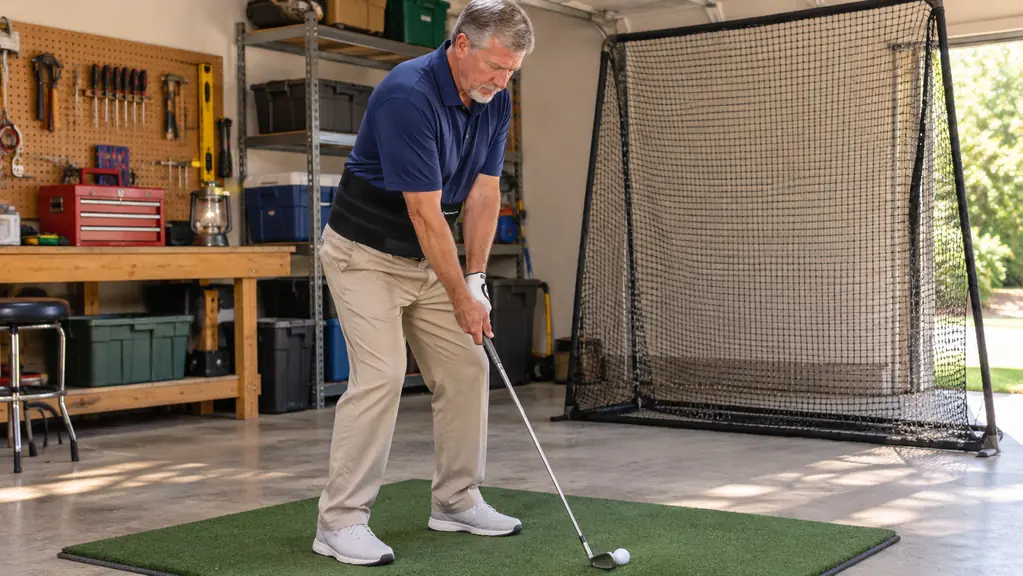
Golf is a moving problem, not a sitting problem. You walk, you bend to tee a ball, you crouch to read a putt, you twist through a swing, and then you do all of it another 70 times. A brace is built for that and a pillow is not. The MUELLER brace delivers firm, targeted compression through 8 steel springs instead of the soft nothing of an elastic wrap. That is the difference I felt the first Saturday morning I wore it to the range, in early April, with frost still sitting in the shade of the treeline. I hit about 60 balls, which is my normal bucket. My back still got tired. It just did not get that sharp, grabby feeling on the follow-through, the one that usually makes me quit at 40 and drive home stiff.
The second win is fit. The sizing is spelled out plainly, which I appreciate, because vague sizing is where most of these things go wrong. Small fits 22 to 30 inches around the widest part of your waist, and One Size fits 28 to 50 inches. I measured myself at the kitchen counter on a Tuesday night with a cloth tape, came out at 41 inches, and ordered the One Size. It landed with room to adjust in both directions, which matters because my waist is not the same in January as it is in July. That range covers most of the men I play league with. Adjustability matters more than people think, because a brace you have to re-set after every swing is a brace you stop wearing by the sixth hole. This one stays where I put it, through a driver swing and through a morning of loading dock work. There is also a one year warranty, and MUELLER has been in sports medicine for over 60 years, which is not nothing when you are buying something that has to survive a full season.
Where a Lumbar Pillow Wins
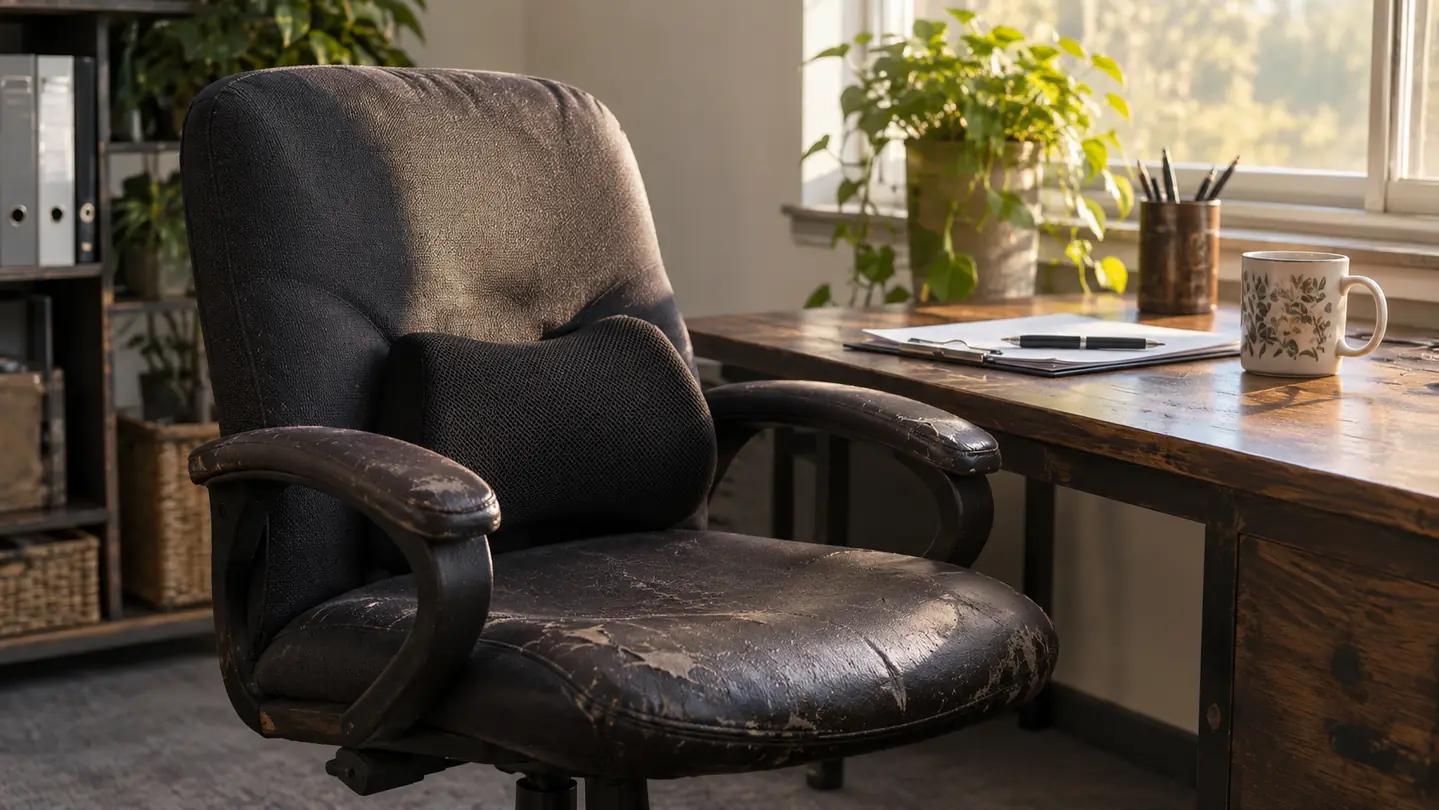
Now the part the brace does not do well. When I am at the shop doing quotes and invoices, I am in a chair for two or three hours at a stretch, and a brace is the wrong tool for that. I found that out the hard way. I wore the brace through an entire Tuesday morning of paperwork, and by lunch I had a hot band across my middle and a fresh ache low on my left side from sitting pinned against the padding. A contoured memory foam lumbar pillow holds a curve at the base of your spine while you sit, and it does it without strapping anything around your waist or adding heat. That is a real advantage, not a participation trophy. If your back aches after a desk day and feels fine on the course, the pillow is the simpler and more comfortable answer.
The pillow also wins on plain comfort. It is soft. You lean back into it and forget it is there. Before I bought one I used a rolled bath towel inside a pillowcase for about a month, and it worked better than I expected, which tells you how little this job really requires. The towel went flat by the second week and I was folding it in half to get the shape back. A proper contoured cushion held its shape all season. A brace is not forgettable by comparison. The MUELLER is made from a neoprene blend along with nylon, polyester, rubber and stainless steel, and neoprene does not breathe much, so by the back nine you are aware of it. On a hot afternoon in July that matters more than any spec sheet can tell you. The brace is also not shaped to hold a seated curve, so treating it as a desk chair substitute misses what it is for. Two different tools, two different jobs.
If your back tightens when you move, not when you sit, start here
8 steel springs, adjustable fit from 28 to 50 inches at the waist, one year warranty. This is the brace that lives in my golf bag pocket, not in a drawer.
Amazon Check Today's Price on Amazon →What the Brace Is Actually Doing, and What It Is Not
Let me be clear about something before you spend anything. The MUELLER brace does not fix a back. It supports and compresses while you are wearing it. My doctor looked at mine years ago and called it ordinary muscle strain and stiffness, nothing surgical, and his advice was to stay active and stop pretending I was 30. The brace fits into that advice. It lets me finish a bucket of balls or a league round without spending the next morning moving like a man twice my age. I tested that claim on purpose one Thursday in June. I played nine holes with the brace, took it off at the turn to see what would happen, and played the back nine without it. By the fifteenth hole I could feel the difference in the finish of my swing. That is a real benefit. It is not a cure, and MUELLER does not claim it is one.
What it is doing, mechanically, is simple enough. The 8 steel springs are what deliver the firm, targeted compression. The adjustable fit keeps that pressure where you set it instead of letting it drift down your hips, which is the exact failure I had with the drugstore wrap. The maker lists it for upper and lower back support and for the sort of everyday strain that comes from lifting, twisting and standing too long. It also lists uses around arthritis, sciatica and sprains, though I can only speak to the stiffness side of that list. Again, that is support, not treatment. If you have something going on beyond ordinary stiffness, go see somebody who can actually look at it. No brace on a shelf is going to sort that out for you.
One more honest note. Wearing a brace all day, every day, is not the plan. I use it for range sessions, league nights, and the days I am loading signage into the truck. Then it comes off. The rest of the week my back does its own work, which is the whole point. A brace that becomes a permanent part of your body is a brace you are hiding behind. My own rule is simple: if I would not wear it in front of my league partners without explaining it, I do not need it on.
I wore the MUELLER for a full league round and a Saturday bucket before I wrote a word about it. The springs are why it works. The neoprene blend is why you notice it by the back nine.
How I Tested Both
I have used both across a full season of Thursday league nights and Saturday range mornings, starting last March and running through the end of October. The brace goes on before I leave the house and comes off in the truck afterward. The pillow lives in my desk chair at the shop and in the passenger seat on the drive to the course, which is about 25 minutes of sitting each way. That is the honest split: one tool for the hours I am moving, one tool for the hours I am not. I kept a note on my phone for the first six weeks, mostly about how my back felt the morning after a round, because the next morning is where the truth shows up. Neither one has ever made me a better golfer. Both have made the day after golf more bearable, and for a man my age that is the whole ballgame.
I also paid attention to the small stuff, because that is what decides whether a thing ends up in the bag or in the drawer. Does the brace stay put through a swing? Yes, and I checked it on the tenth tee more than once out of habit. Does it make me sweat? Yes, more than I would like, and by August I was wearing it against skin instead of over an undershirt because the shirt underneath was worse. Does it roll up small enough to live in a golf bag pocket? It does, and that is where mine sat for most of the season. Does the pillow survive a car seat and a desk chair without going flat? Mine has. Would I rebuy either one? The brace, in a second. The pillow, when this one gives out, which is a different and quieter kind of endorsement.
What I Liked
- 8 steel springs give firm, targeted compression rather than a soft elastic wrap
- Adjustable fit covers 28 to 50 inches around the waist in One Size
- One year warranty from a company that has been in sports medicine for over 60 years
- Wearable while you swing, walk or lift, so it works during the round and not just after it
- Listed for upper and lower back support
Where It Falls Short
- The neoprene blend runs warm and you feel it by the back nine
- Sizing is not guesswork, you have to measure your waist before ordering
- It supports, it does not treat anything
- Not built for all-day seated wear, which is the pillow's job
Who Should Buy Which
Buy the MUELLER brace if your back tightens when you are active and feels better when you rest. Golfers, guys who lift things for a living, anyone whose back complains after a range session or a long walk. Buy it if you want something you can wear while you swing, with a fit range that goes to 50 inches at the waist and a one year warranty behind it. My own test is simple: if you can point to a specific activity that sets your back off, and that activity involves standing or moving, the brace is aimed at you. Skip it if you are looking for something to lean against for eight hours a day, because that is not what it is built to do and you will end up disappointed in a product that did nothing wrong.
Buy a lumbar pillow if your back aches after a desk day and the course is fine. It is cheaper, it is more comfortable, and it does its one job without any fuss. Some of you should buy both. I did, and the arrangement has held up for a full season: brace for the moving hours, pillow for the seated ones. If you are on the fence, buy the brace first. It is the one that protects the thing you actually want to keep doing, which for me is walking 18 holes on a Thursday night with the league instead of watching from the clubhouse. What I would not do is buy the brace expecting it to fix a chair problem, or buy the pillow expecting it to carry you through 18 holes. That is how a decent product ends up getting called a waste of money by somebody who aimed it at the wrong job.
The back brace I would buy again without thinking about it
Adjustable, 8 steel springs, one year warranty, and it fits under a polo shirt without announcing itself. Check today's price and read the reviews from people with worse backs than mine.
Amazon Check Today's Price on Amazon →