

The morning after league night is the honest part of the week. Not the good drive on 7. Not the two putts that dropped. Not the story I will tell at the sign shop on Friday. It is Wednesday at 6:40 in the morning, sitting on the edge of the bed, deciding whether my lower back is going to let me stand up on the first try or the third.
I am 57, I own a small sign shop in central Ohio, and I have played the same Thursday evening league for 25 years. My handicap has sat around 14 for a decade and it is not going anywhere. What changed is that a range session or a full 18 started leaving my lower back stiff by dinner and worse the next morning. My doctor looked at it years ago and called it ordinary muscle strain and stiffness, nothing surgical. So I went looking for something that would hold things together for four hours, not something that would fix me. The MUELLER Sports Medicine adjustable back brace is what I landed on. I have now worn it through four months of Thursdays, Saturday range sessions and a lot of garage-net swings, and I have opinions.
The Quick Verdict
Eight steel springs give it a firmness the stretchy belts do not have, and it stays put through a full round. It is a support, not a repair, and it gets warm on the back nine.
Amazon Check Today's Price →Eight steel springs, one strap, and a lower back that stops arguing by the 14th hole
This is the brace that stayed in my golf bag while three others went to the donation pile. Measure around the widest part of your waist before you order, because the size range is generous but not foolproof.
Amazon Check Today's Price on Amazon →How I've Used It
Four months, give or take. I wear it for league on Thursday evenings from the start of the season, for most Saturday morning range sessions, and for the long garage sessions where I am working on one thing and hit 60 balls without noticing. I do not wear it at the shop. I do not wear it to bed. It lives in the side pocket of my golf bag next to a spare glove and a roll of tape, which is where it will stay until it falls apart.
The first round I wore it was a cold April Thursday, 47 degrees with a wind out of the northwest that had everybody in my group done talking by the third hole. I strapped it on in the parking lot while the truck was still ticking, walked to the first tee, and spent the front nine half convinced that my league partners were studying my waist instead of my swing. Nobody was. By the sixth hole I had stopped noticing it, and by the turn I was thinking about my grip again. Gear you forget you have on is gear that works, and that was most of my evaluation right there.
The routine matters more than the product, so here it is. I put it on in the parking lot before I take the clubs out of the truck. That is the part I got wrong for the first month. Waiting until hole 12 to strap it on is like putting sunscreen on at four in the afternoon. The whole point is that the support is there while you are doing the thing, not after the thing has already gone badly.
And let me be straight about what I am claiming. I am not going to tell you it lowered my scores. I shot 91 in April with it on and I shot 91 in July with it on. What I will tell you is that I stopped cutting Thursday rounds short, that I stopped skipping the range on Saturday because I was worried about Sunday, and that the walk from the truck to the house after league stopped being a slow shuffle. My handicap has not moved. My week has.
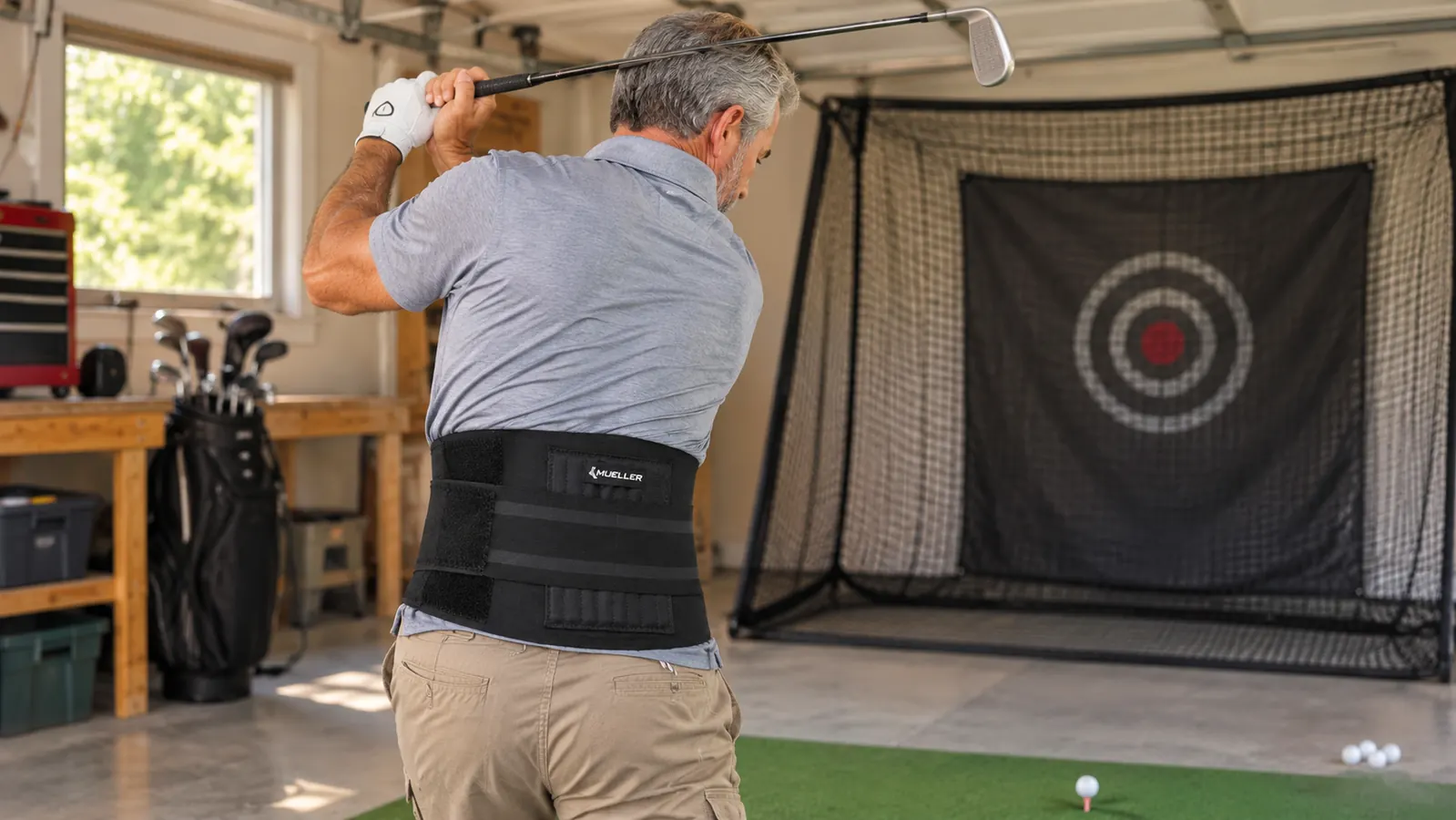
What Eight Steel Springs Actually Do
The back panel carries eight steel springs, and they give the panel a firmness that a plain elastic wrap cannot match. That is the whole difference between this and the stretchy belts I tried first. Elastic goes around you and squeezes, then folds and rolls up the moment you bend. The springs hold a shape, so when you set up over a wedge and your lower back wants to round out, the panel pushes back a little instead of following you down.
Before this I went through two of the elastic wraps, the kind that come rolled in a box for about the cost of a dozen balls. The first one folded in half every time I bent to tee a ball and ended up bunched under my ribs by the fourth hole. The second had a hook and loop panel that grabbed my shirt on every swing and made a tearing sound loud enough that a guy two bays down at the range looked over. Neither of them failed because they were cheap. They failed because they had no structure. A wrap that follows your body around cannot tell your body to stop rounding, and that is the difference I keep coming back to with the MUELLER panel.
I noticed it most on the range, not on the course. On the range I am hitting ball after ball in the same posture for 45 minutes, which is a lot more repetition than a round gives you. Somewhere around ball 30 the panel was doing work my muscles had been doing, and I finished the whole bucket instead of quitting at 40 balls. That is the test I care about, because the range is what makes the next round feel decent.
The build is a neoprene blend with nylon, polyester, rubber and stainless steel in it. Firm against the back, but not a hard shell, so it bends enough that you can still swing. It weighs 0.4 kg, just under a pound, which means it does not pull at your shoulders or drag your shirt down on the follow-through. The stainless steel in the springs is the reason the panel has kept its shape on mine through a wet spring and a hot July.
The Fit: Measure the Wrong Place and You'll Regret It
Ordering is the one place people get this wrong, and I got it wrong first. The sizing note says to measure around the widest part of your waist. I measured where my pants sit, which is not the same place, and then I talked myself into the small on the theory that a smaller brace would press harder and work better. It would not close around me. I sent it back and ordered the one size, which is listed at 28 to 50 inches. The small is listed at 22 to 30.
On the one size I measured 41 inches on a cloth tape over a t-shirt, which put me comfortably in the middle of the range. That middle is where you want to be. If I had come in at 48 or 49, I would have been nervous about how much closure overlap was left over, because a brace that just barely meets itself has nothing left to snug. Somewhere north of 47, order with room to spare and plan on the overlap, not on the number on the label. A gap at the closure turns a support into a belt.
The adjustment itself is a strap and a closure you set once and then leave alone. I found my setting in the first week and I have not touched it since. Snug enough that I notice it for the first couple of holes and then stop thinking about it. There is no dial, no pump, no gauge. It is a strap on a firm panel, and that turns out to be enough.
Through 18 Holes, and Through the Morning After
The real test is not the swing. It is the four hours around the swing. A round is not 70 golf shots, it is 70 shots spread across a lot of standing, walking and sitting down in a cart. The brace handles that stretch better than I expected because the panel does not shift when I sit. The cheaper wraps I tried would ride up every time I got in the cart, and by the back nine I was fighting the gear instead of playing golf. This one stayed where I put it.
There is a smaller thing I did not expect. The panel tells on you. Twice on the back nine in June I quit on a shot, lifted with my arms and spun out instead of turning through, and I felt the front of the brace press hard against my stomach before the ball was halfway to the green. That feedback is free, and it is worth more to my swing than the support itself. I would not buy it for that reason alone, but I am not going to pretend it has not helped.
I also tested it on a day I should have stayed home. Cold, damp, a league round that ran long because the group ahead of us could not find the fairway. I finished 18 and I drove home and I did not lie on the floor of my shop for twenty minutes afterward, which had become my Thursday routine. Take that for what it is worth from one guy with one back. It is not a study.
The morning after is a mixed bag. The brace does nothing for you overnight because you are not wearing it overnight. What I noticed after a month is that the Wednesday stiffness got less severe, but I think that is because I stopped riding the last four holes and stopped cutting rounds short. The brace did not fix my back. It let me play enough that my back got used to playing again.
Heat is the real cost. Neoprene does not breathe. On a 90 degree Ohio afternoon in July, the panel is warm and damp by the 12th hole and I am ready to take it off in the parking lot before I take my shoes off. I put up with it because the alternative is not playing. If you run hot, you will notice, and you should plan on it.
What It Doesn't Do
It does not fix a bad back and it is not sold as something that will. It does not replace the twenty minutes of stretching I do on the living room floor, which has done more for me than any piece of gear. It does not make you swing better. It does not stop you from swinging badly, and I have proof of that from every Thursday since April.
It also does not hide under a polo shirt. It is a visible piece of equipment. My league partners noticed it and asked, I said it was for my back, and that was the entire conversation. If you are the sort of guy who would rather be sore than be seen wearing a brace, this will sit in your bag and you will have wasted your money.
The listing carries a one year warranty, which tells you what the company thinks of its own stitching. Mine has held up through weekly use with no loose thread. I rinse it by hand in cool water and hang it over the shop sink to dry, never in the machine, and it has kept its shape and its closure.
What I Liked
- Eight steel springs hold the panel's shape, so it resists the lower back rounding out instead of just squeezing
- The strap sets once and stays set. No dials or pumps to fiddle with between shots
- One size is listed at 28 to 50 inches, so most men can order without guessing twice
- Stays in place when you sit down in the cart, which the cheap elastic wraps do not
- At 0.4 kg it is light enough that it does not pull at your shoulders through a round
Where It Falls Short
- Neoprene holds heat. On a hot afternoon you will want it off by the 14th hole
- Visible under a shirt, and bulky enough that you would not wear it around the office
- Does nothing for the overnight stiffness, because you are not wearing it overnight
- Easy to order the wrong size if you measure where your pants sit instead of the widest part of your waist
It did not lower my score by a single shot. It got me through 18 holes on a Thursday and out of bed on a Wednesday, and at 57 that is the trade I was looking for.
Who This Is For
This is for the golfer in his 40s, 50s or 60s whose lower back tightens after a range session or a round and is worst the next morning, and who has already been looked at and told it is ordinary muscle strain and stiffness. It is for someone who wants to keep playing his weekly game and is not chasing a repair. If that is you, the MUELLER brace is the version of this idea that I would buy again.
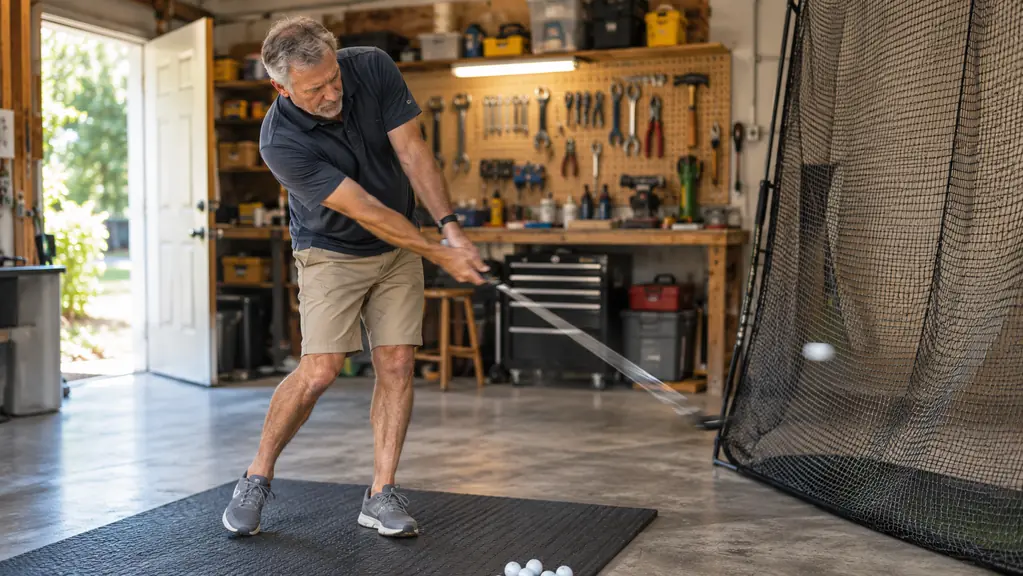
It is also for the guy who practices in the garage. I hit into a net on a mat for 40 minutes at a time, and the posture is worse than the course because nothing interrupts you and nobody is watching. That is where I notice the panel most, and that is where I would have quit without it. If your practice happens in a bay at a public range instead, the same thing holds, because a bucket lasts longer than a round's worth of swings and you never get the walk between shots to loosen up.
Who Should Skip It
Skip it if there is anything going on beyond ordinary stiffness, because a brace is not a diagnosis and no review on the internet is one either. Go get looked at first. Skip it if you play in heat and cannot stand being damp for four hours. Skip it if you will not wear something visible. And skip it if you want a device that inflates or beeps or reports something back to you, because this is a strap and a firm panel and nothing else.
Skip it too if you are hoping it replaces the boring work. The stretching and the short daily round of hip and hamstring work has done more for my back than any brace ever will. What the brace buys you is the round itself, the four hours on a Thursday with your league. It does not buy you the recovery. That part is still yours.
The one that lives in my golf bag, not the one I reviewed and forgot
If a stiff lower back is what stands between you and a full 18, this is the brace I keep coming back to. Measure around the widest part of your waist first, then order. One year warranty, one size covering 28 to 50 inches.
Amazon See the MUELLER Back Brace on Amazon →