

My lower back starts talking to me around the ninth hole. Not screaming. Just talking. By the time the clubs are in the truck it has moved into a dull argument, and by the next morning it is a full negotiation just to stand up straight and reach for the coffee. I am 57, I own a small sign shop in central Ohio, and I have played a Thursday evening league for 25 years at around a 14 handicap. My back has been part of that conversation for a while now. My doctor looked at it years ago and called it what it was: ordinary muscle strain and stiffness. Nothing surgical. Nothing dramatic. Just a lower back that tightens up after a range session or 18 holes and complains loudest the next morning. For a long time I treated that as the price of playing golf. It isn't.
What finally changed my week was boring and unglamorous. I bought a MUELLER Sports Medicine adjustable back brace and I built a routine around it. That is the short version. The brace is adjustable, it carries eight steel springs across the back panel, and the one size fits a waist from 28 to 50 inches. MUELLER has been making sports medicine gear for over 60 years, and this particular brace carries a 4.3 star average across roughly 16,000 reviews, which is about the ratio you want on something that either fits you or does not. It is not a cure and it will not fix your swing. What it did for me was let me keep hitting balls while I sorted out the rest. Here is the routine, in the order I actually do it.
The brace goes on before the first ball, not after the first twinge
Adjustable fit from 28 to 50 inches, eight steel springs for firm compression across the lower back, one-year warranty. Mine lives in the side pocket of the bag.
Amazon Check Today's Price on Amazon →Step 1: Measure Your Waist and Buy the Right Size the First Time
MUELLER builds this in a Small that fits 22 to 30 inches and a One Size that covers 28 to 50 inches. You measure around the widest part of your waist. Not your pants size. Not where you wear your belt, which for me sits lower than the widest point. I measured 39 inches at the widest part and the One Size has room to spare on both ends of its range. If you land right at 30 inches, you have a real decision to make, and I would go with the One Size so you have room to loosen it on a hot day rather than running out of adjustment in July.
The first time you wear it, put it on over a thin shirt rather than against bare skin, and wear it for an hour at home doing normal things. Sit down in it. Bend over to pick up a dropped remote. Get in and out of the truck. The material is a neoprene blend with nylon and polyester, and it does not breathe like a cotton t-shirt. You want to learn that on your own couch and not on the 14th fairway with the group behind you waiting.
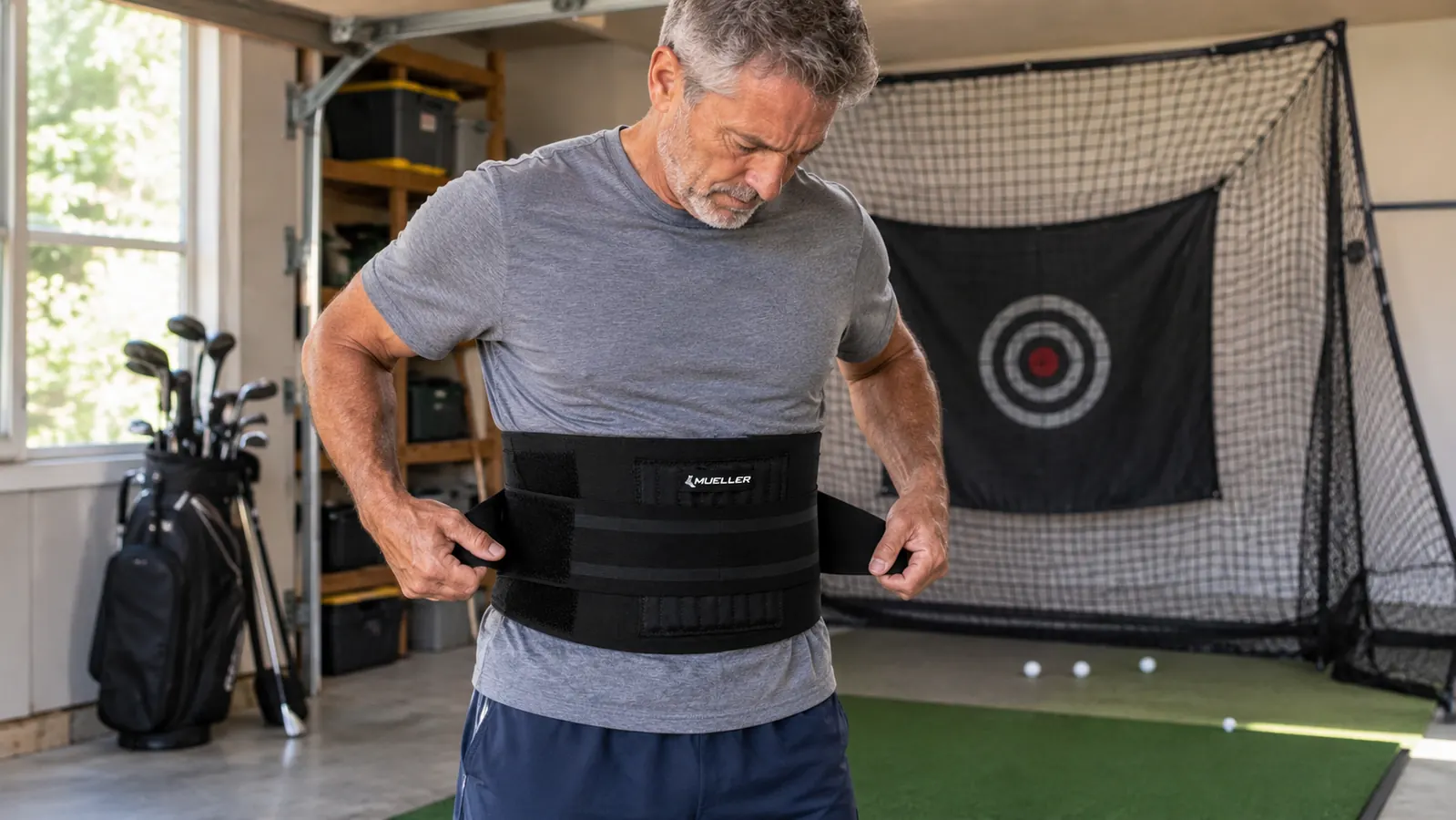
Adjustment matters more than tightness. It should feel like firm support around your middle, not like a hand squeezing the air out of you. I got this wrong early. I cinched it as tight as it would go because tighter felt like it was doing more. It isn't. Too tight and you cannot take a full breath at the top of your backswing, and a shallow breath produces a short, stabby little swing that is worse for your back than the loose one you were trying to avoid.
Step 2: Put It On Before the Range, Not After the Pain
The brace does nothing for you sitting in the truck. I put mine on at home, before I leave, so it goes onto a back that is still loose rather than one that has already tightened up over a 20 minute drive. On range mornings the order is warm-up first, brace second, first ball third. It sounds fussy written down. It takes ten extra minutes and it is the difference between a session that helps and a session I spend managing a back that has already gone stiff.
The eight steel springs are what you are actually paying for. They run vertically across the back panel, they are firm, and they hold a steady compression across the lower back while you are bent over a ball. That is the whole job. Support and a reminder. My doctor was clear on this and so is the label if you read it: it supports, it does not treat. No brace on the market turns a strained muscle into a healthy one, and any product page that hints otherwise is selling you something.
Take it off for the parts of the round that do not need it. I generally leave mine on for the whole 18 because taking it off and refastening it half a dozen times is more hassle than it is worth. But for a long putting session, or a slow lunch at the turn, off is fine. Do not sleep in it and do not wear it on the couch all evening. It is a golf and yard-work tool for me, not a permanent garment.
Step 3: Shorten the Swing and Let the Brace Coach Your Turn
A back brace will not fix a bad swing. It will not fix a reverse pivot and it will not add ten yards. What it does do is give you feedback you can feel through a shirt. When I make a big, loose, over-rotated turn with my shoulders and nothing from the hips, the brace rides up on one side. When I set up with my feet slightly flared, soften the knees, and let the hips lead, the brace stays put and my lower back stays quiet. That is the whole trick. It is a feel cue you cannot ignore, and I did not have one before.
I also shortened everything. Instead of trying to hit a 7 iron 155 yards, I hit it 140 with a three-quarter swing, a smoother tempo, and one more club in my hand. My handicap has not moved much, still hovering around 14 where it has lived for years, but I get to the truck without the argument. Tee the ball a touch forward, narrow the stance a hair, and think about turning your belt buckle instead of your shoulders. Those three changes take a surprising amount of load off the lower back.
Practice swings are where I would be careful. That is where I used to make 20 rehearsal swings at full speed, back to back, before I ever hit a ball. That is exactly the load the brace exists to moderate, and doing it 20 times in a row defeats the purpose. Now I make two, slow, feeling the turn, and then I hit a ball. Fewer reps, better reps.
Step 4: Rebuild the Warm-Up Around Hips and Glutes
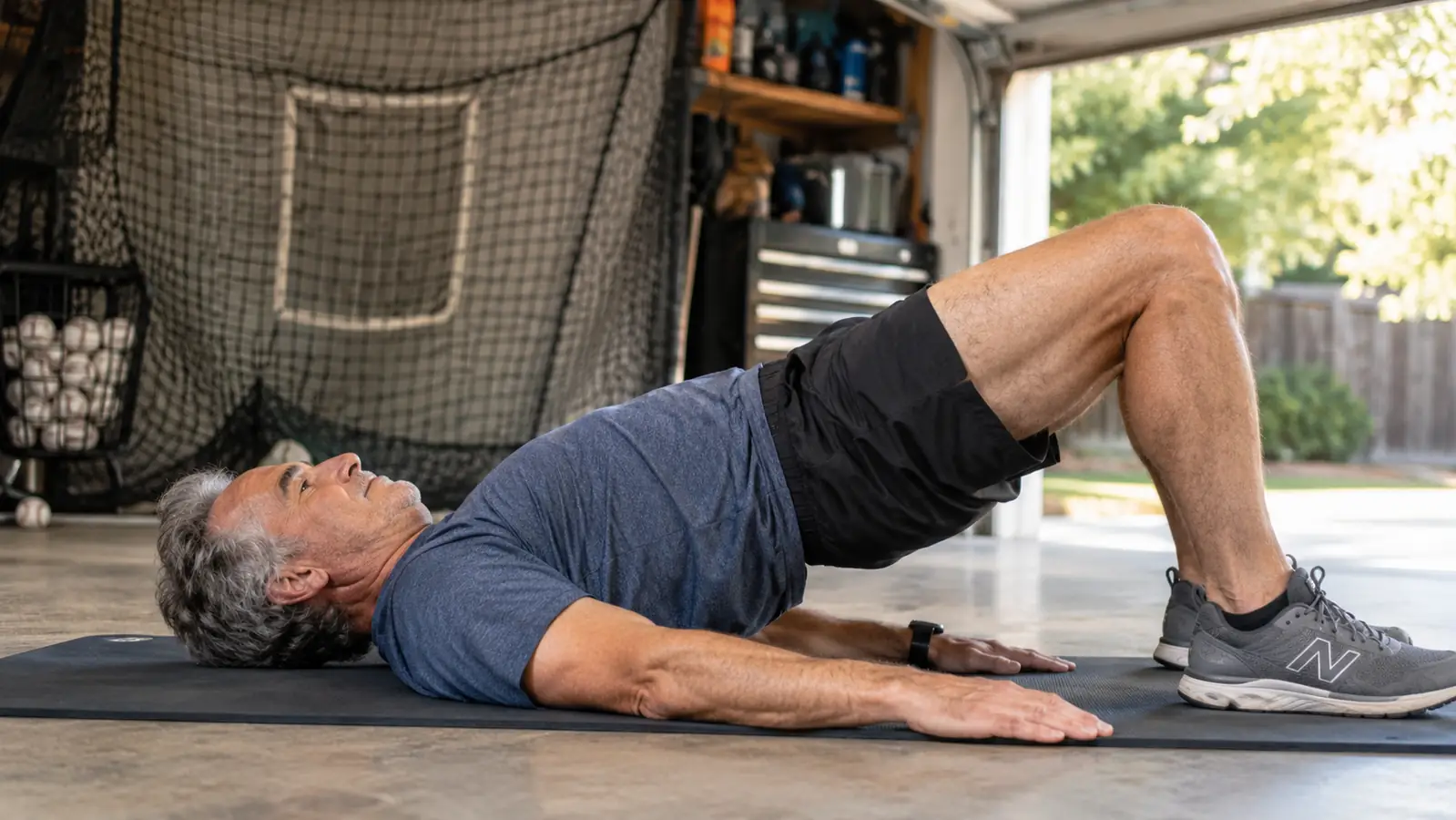
The brace is the last thing I put on, not the first thing I do. Before it goes on I spend eight to ten minutes on a mat in the garage. Slow spinal movement for a minute. Ten glute bridges, holding the top for a two count. A hip flexor stretch on each side, 30 seconds per side. Standing leg swings, ten each way. Then a couple of easy torso rotations with a club across my shoulders, well short of where I can actually turn.
Here is the reasoning, and it took me two wasted seasons to accept it. A tight lower back is often a stiff hip and a sleeping glute. If your hips will not rotate, your lower back rotates for them, and that is the motion that leaves you stiff the next morning. The brace supports the part that hurts. The warm-up works on the part that is causing it. Doing one without the other is why I spent a few years buying things that never quite worked.
At the range, start with a wedge and hit 15 easy ones before you touch a driver. I know. Nobody wants to hear that. But the first ten balls are the most dangerous ones you will hit all week, and hitting them with a driver at full speed on a cold back is how a Saturday morning turns into a Saturday on the couch with a heating pad.
Step 5: Cap Your Volume and Know When to Stop
I count full swings now. Forty at the range, not 120. On the course I play my normal round and I do not add a bucket afterward. That sounds like nothing. It was the single biggest change I made, bigger than the brace, bigger than the warm-up. Volume is what accumulates into next-morning stiffness, and nobody counts volume because it is not as satisfying as buying something.
The other rule is a stop rule. Discomfort that stays in the lower back and eases when I stand up and walk is one thing. Pain that shoots below the belt line, runs down a leg, or comes with numbness or weakness in a foot is another thing entirely, and that is a phone call to the doctor, not a tighter brace. Same for anything that wakes you up at night. I ignored that once. I do not anymore.
Write it down, too. I keep a pad in the shop with three columns: date, number of balls, and how the next morning went. After a month the pattern is obvious and you stop guessing about what is and is not working for you.
What I Liked
- Eight steel springs give firm, steady compression across the lower back
- Adjustable closure with a one size range covering 28 to 50 inches
- One-year warranty and a brand that has been in sports medicine for over 60 years
- Goes on over a shirt in about ten seconds and folds into a golf bag pocket
Where It Falls Short
- The neoprene blend runs warm on a humid July afternoon
- It supports, it does not treat, and the real work is still yours
- Rides up on one side if you cinch it too tight or too high
- Not something I would want to sit in for nine hours at a desk
What Else Helps
The brace is one piece of the week. The other pieces are cheaper and duller. A ten minute walk the evening after a round moves more through a stiff back than any gadget I have bought. Sleeping on my side with a pillow between my knees helps me, and I know that sounds like something your mother would tell you, but it does. A warm shower before you leave the house helps. So does sitting down between shots instead of standing around with your hands on your hips for four and a half hours.
If you are going to spend money on one thing, spend it on the thing that travels to the course with you and gets used every round. For me that was the MUELLER brace, because it is small, it goes in the bag, and I do not have to talk myself into using it. It is not a big purchase, it carries a one-year warranty, and mine has held up through two full seasons of league nights and Saturday range sessions without the springs going soft.
Eight steel springs and a waistband that reaches 50 inches will not fix a reverse pivot. What they will do is let me take 40 swings on a Saturday instead of 15, and get out of the truck on Sunday morning without a negotiation.
None of this is exciting. It is measuring your waist, warming up before you swing, wearing a brace that supports and does not treat, and putting the bucket down when your body tells you to. I play the same course I have played for 25 years with the same Thursday league, and I still walk off 18 tired and a little stiff. I just do not pay for it all day Sunday anymore, and at 57 that is the whole ballgame.
The one thing in my golf bag that is not a club
Adjustable from 28 to 50 inches, eight steel springs, one-year warranty. Measure your waist first, put it on before the range, and let it do its one job.
Amazon Check Today's Price on Amazon →