
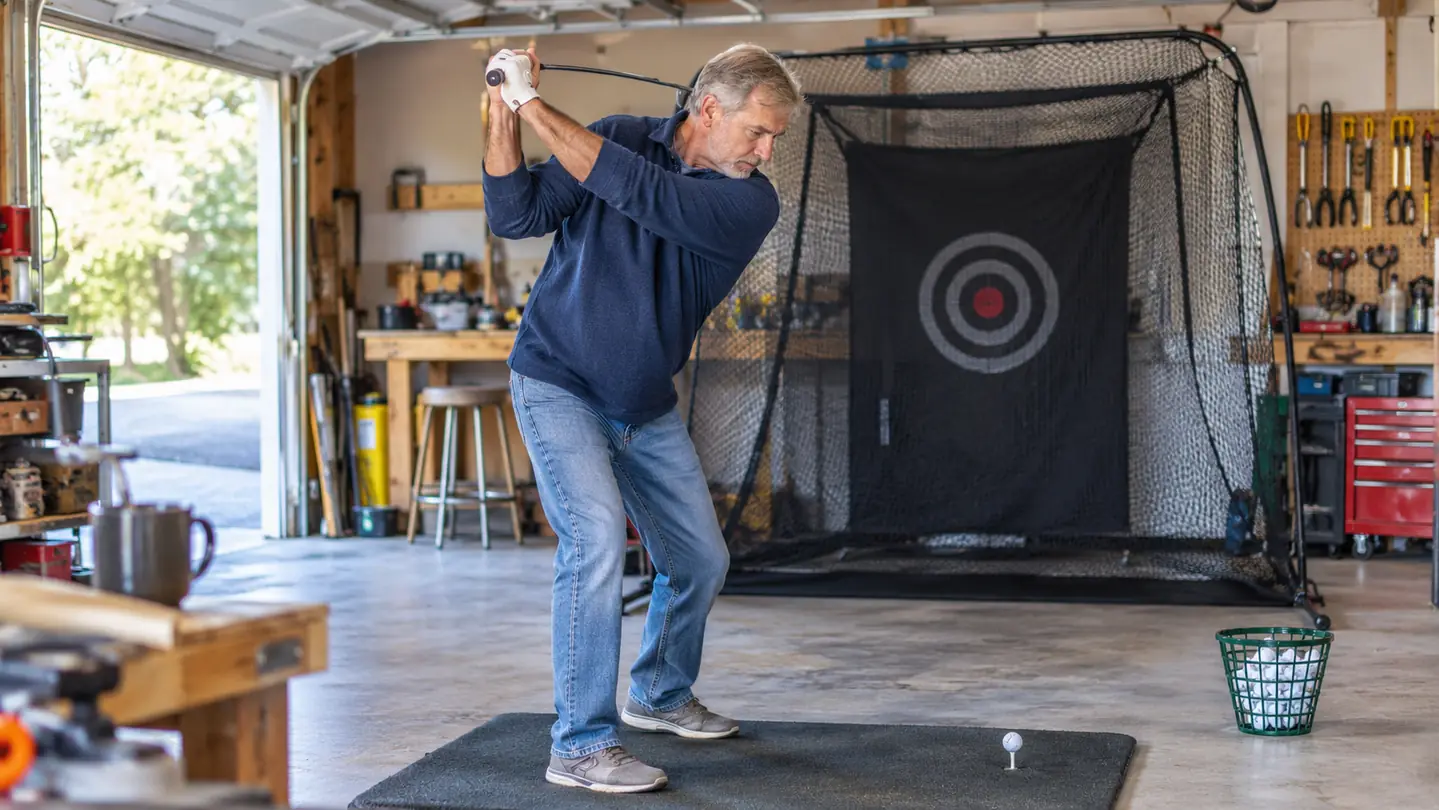
My handicap has sat at 14 for about six years. Twenty-five years of Thursday night league golf, and the number just parks there. What finally nudged it was not a new driver or a lesson package. It was forty swings in my garage on a Tuesday night, in the twenty minutes between locking up the sign shop and walking into the house for dinner. That is the whole argument for a hitting net, and it is also where most people get it wrong. They set one up, whale at driver for an hour, and quit inside a week because their back hurts and nothing changed. I know, because I did exactly that first.
The GoSports net hanging in my garage is the 10 by 7 ft size, and it has been up and down more times than I can count. Part of that is a cheap setup problem. Most of it is a practice problem. A net returns nothing to you but the feel of the swing and the sound of contact, so if you do not give it something to measure, it will happily let you groove the same over-the-top move for a thousand balls. What follows is the sequence I use now, after two winters of doing it wrong first.
The net that lives in my garage, not the one I wish I had bought
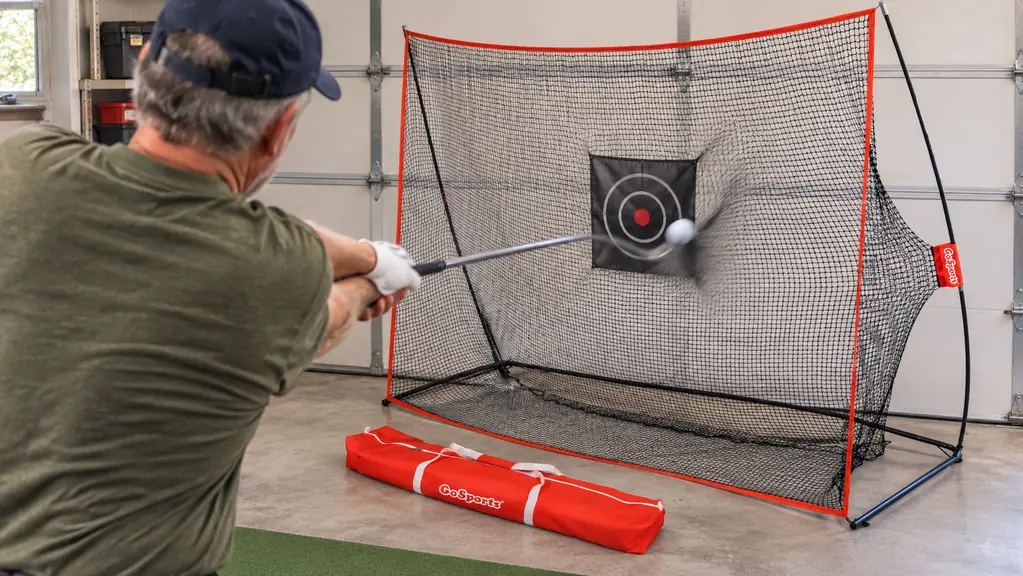
10 by 7 ft of nylon, 20 pounds, five frame pieces and four tent poles, a target square, and a case for when the season ends. That is the entire thing. The mat is on you, and I will get to that.
Amazon Check Today's Price on Amazon →Why a Net Beats Another Training Aid
I have a basement shelf of training aids. A swing trainer with a weighted head, a plane board, a grip gizmo, a putting arc. Most of them taught me something for a week and then went on the shelf, because using them required setting up a station and I had twenty minutes, not an hour.
A net is different in a boring way that turns out to matter. It is either already standing or it is thirty seconds from standing. That is the whole advantage. The best practice tool is the one that fits in the gap between work and dinner, and for me that gap is short and unpredictable. A net needs no car trip, no bucket, and no daylight.
It also does one thing no gadget does, which is let you hit a real golf ball at real speed without a machine telling you what you did wrong. You feel the strike, and that is it. Turns out that is enough when you do it forty times a night, three nights a week, for four months.
A Home Practice Setup in Five Steps
Step 1: Measure Your Space Before You Pick a Size
GoSports offers this net in 10 by 7 ft and 7 by 7 ft, and the choice is not about how far you hit the ball. It is about ceiling height and floor depth.
My detached garage has an eight foot ceiling and about eleven feet of clear floor from the back wall to where the car sits. The 10 by 7 stands against that back wall with the net hanging forward and I have room to swing a driver without the clubhead finding drywall at the top. If your ceiling is lower, or you are setting up in a basement, take the 7 by 7 and do not feel bad about it.
Two measurements matter more than net size. First, get in your address posture with your longest club and have somebody watch the top of your backswing. That is your real ceiling requirement, not a guess. Second, leave yourself three or four feet between the ball and the net panel so you can actually see the ball fly into it. Too close and the ball is a blur. Too far back and you start watching instead of swinging.
Step 2: Assemble It Once With Daylight and Patience
The GoSports box holds five metal frame pieces, four tent poles, the net itself, a target, and a carrying case. Twenty pounds altogether. My first assembly took about fifteen minutes in the garage with a work light on, and most of that was figuring out which pole went where.
Build the frame first with clear floor around it. The nylon has some give, and threading it is much easier when you can walk around both sides of a standing frame instead of wrestling it flat on the concrete. The second assembly took me seven minutes. Now it goes up faster than the coffee maker finishes.
Two changes from the instructions. I set the frame feet against the back wall so a shanked ball cannot walk the whole thing across the garage. And I hang the target square in the middle of the panel at about chest height, not down low, because a low target teaches you to hit down on everything, driver included. When the season ends, it all folds into the case and leans in the corner behind the snowblower.
Step 3: Build a Stance Station on a Mat
The net does not come with a mat, and that is worth saying plainly because it is the piece people forget. Bare garage concrete will wreck your wrists and elbows long before it wrecks your swing. I use a four by five mat I already owned from years of range buckets. If you are starting from nothing, buy a decent mat, because the mat is what protects your joints, not the net.
Then mark your stance. I have two strips of gray gaffer tape on the mat, one for where the ball sits with a 7 iron and one for driver. That is the entire training station, and it solves the problem you cannot feel, which is drifting. Without those marks I creep an inch and a half closer to the ball every few weeks and then cannot understand why I am suddenly living on the hosel.
If tape on a mat feels fussy, an alignment stick on the floor behind your heels does the same job. Either way the point is that your feet go to the same place every session, so the only thing changing in the garage is your swing.
Step 4: Cap the Session at Forty Balls
Twenty minutes and forty balls is the whole session, and the cap exists because of my lower back. It tightens up after a long range bucket, worst the next morning. My doctor called it ordinary muscle strain and stiffness years ago, nothing surgical, and I mention it because the garage is where I can make that better or worse depending on how I use it.
The order never changes. Fifteen wedges at half speed, just feeling the club pass through the ball. Fifteen mid irons at maybe seventy percent. Ten driver swings, and only ten. Then I stop, whether it is going well or not.
The temptation is driver for an hour, because driver is the fun one. Resist it. In a net you cannot see ball flight, which means a hundred driver swings is a hundred swings of guessing. Short clubs at partial speed give you something real to feel: where the club strikes the mat, whether you are coming from inside or over the top, and whether you finished balanced or falling at the target. Three or four nights a week in winter, twice a week in season. It has not made me longer. It has made the bad miss less bad, and at a 14 handicap that is the whole game.
Forty balls, three nights a week, in the twenty minutes between locking the shop and walking in for dinner. That is the whole program, and it is the only practice I have ever kept up with.
Step 5: Use the Target for Start Line, Not Bullseyes
The included target is more useful than it looks, just not the way you would guess. I am not trying to hit the square. I am using it to check start line. If a 7 iron from eight feet away lands consistently a foot left of that target, my path has moved, and I know it before it costs me a hole on Thursday.
What the net cannot tell you is distance, curve, or how the ball finishes. It also will not punish a quick transition, so snatchy tempo feels fine in the garage and shows up as a block on the course. Every couple of weeks I take the same swing to the range on a Saturday morning and let real ball flight tell me the rest. The garage is for repetition and feel. The range is for truth.
And if you are fighting a two way miss or a slice that keeps getting worse, no net fixes that. Get a lesson, then use the net to repeat what the pro told you. That combination, one lesson plus a net, has done more for me than three training aids sitting in my basement.
Where the Net Falls Short
The honest limitations, since a product listing is not going to hand them to you. The net tells you nothing about ball flight. You can hit what feels like a beautiful high draw into that nylon and have it be a low hook. Practice for a month without seeing a real ball flight and you will get very good at a swing that only works in your garage.
Second, it is not a substitute for instruction. A net is a repetition machine. Put a bad move into it four hundred times and you get a very reliable bad move. My first winter I grooved an early extension that took a pro about ten minutes to spot and most of a summer to unwind.
Third, this is outdoor gear that lives indoors. The frame is metal and the net is nylon, so a damp basement is not its friend. Mine comes down in the humid months and goes back up in October. If yours stays out year round, run a fan or a dehumidifier and check the frame joints in the spring.
What Else Helps
Two more things made these sessions stick, and neither one costs anything.
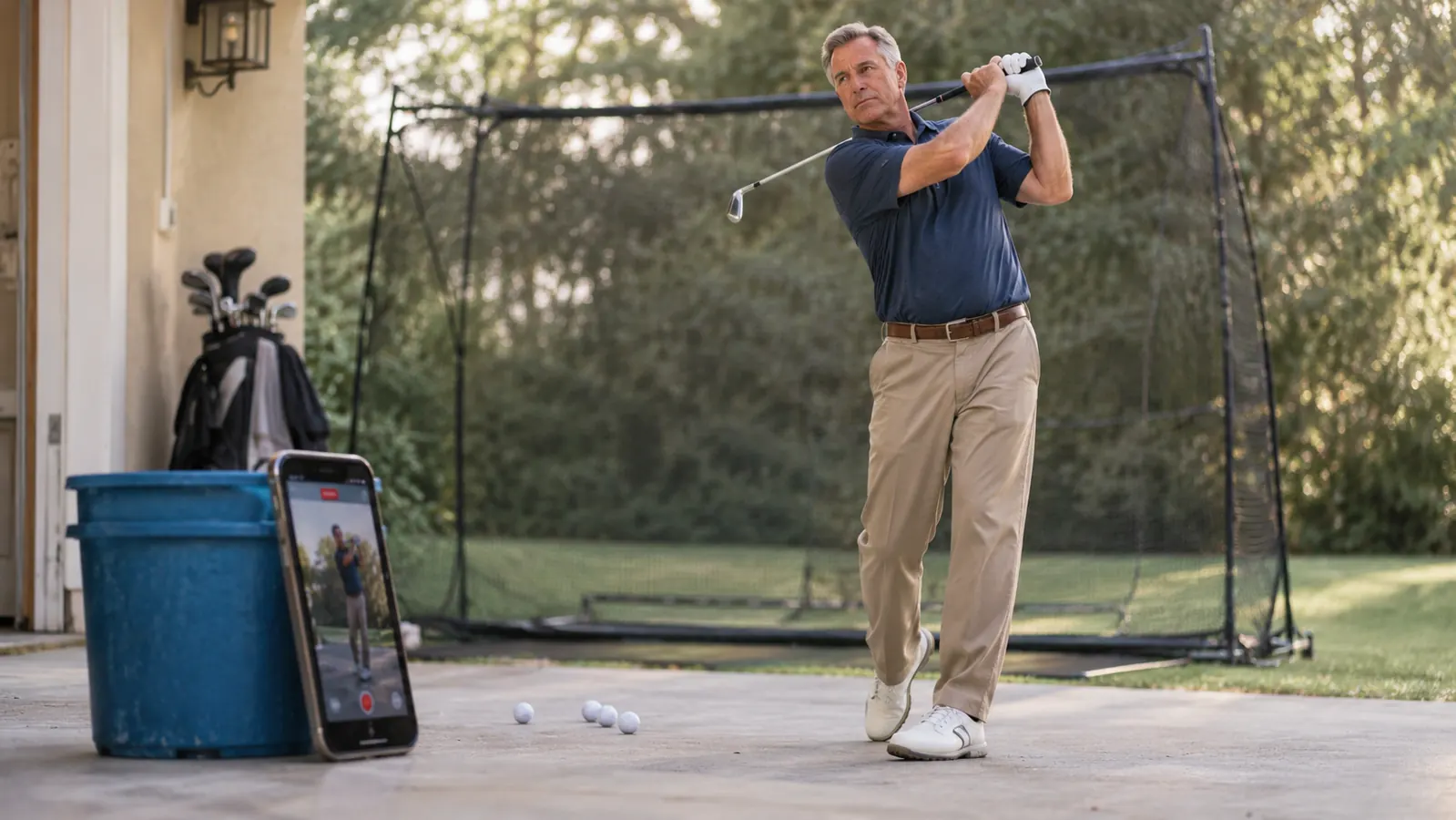
The first is a phone propped on a bucket, filming down the line from hip height. Not every swing, just five or six at the end of a session. You do not need an app or a tripod. You need to see whether your setup looks the way it feels, and it almost never does. The first time I did it I found out my shoulders were aimed twenty yards right of where I thought they were.
The second is a hard stop on the clock. Twenty minutes, then the net comes down or I walk away. Practice that runs long turns into swinging, and swinging is how you bake in the habits you were trying to lose.
If you are weighing a net against a range membership, understand they do different jobs. The range gives you ball flight, a bucket, and a stranger two stalls over who hits it forty yards past you. The net gives you repetition at home in the time it would take to drive to the range and back. I do both. If I could keep only one I would keep the range, but my winters would be a lot worse for it.
Twenty minutes in the garage beats a bucket you never get around to
The 10 by 7 ft GoSports net, 20 pounds, up in about fifteen minutes the first time and seven after that. Add a mat and two strips of tape and your station is finished.
Amazon Check Today's Price on Amazon →