
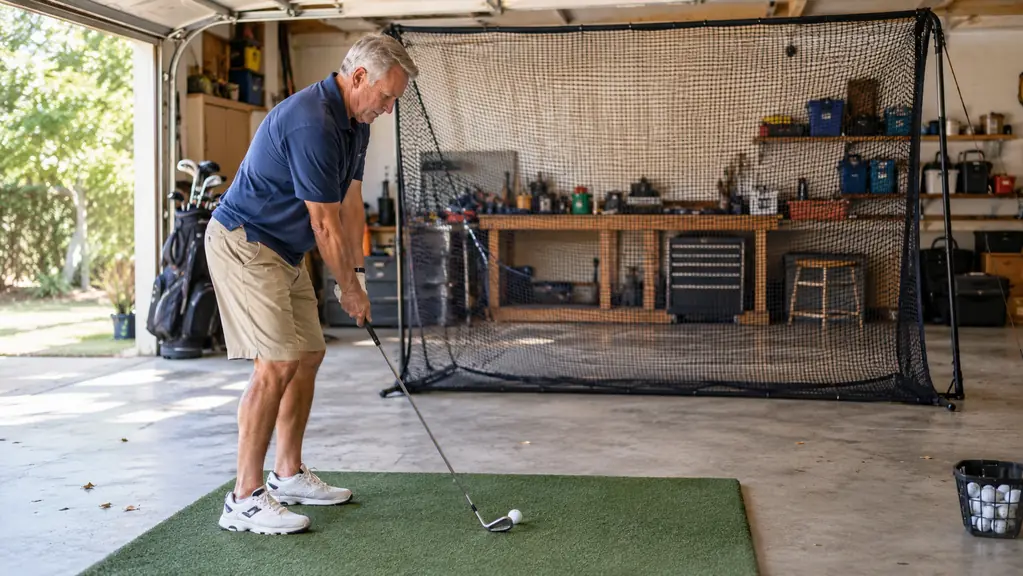
The net has been standing in the left bay of my detached garage since the middle of last winter, and I have hit into it maybe four thousand times. My back is what drove the purchase. Twenty-five years of Thursday night league golf and I am 57 now, and last November I came home from a Saturday range session so stiff that the next morning I had to sit on the edge of the bed and think about it before standing up. The range costs me a bucket and a drive each way, and after the drive home I am cold and tight and the whole session is nearly wasted.
So I bought a GoSports golf practice hitting net, the 10 by 7 foot model, and set it up in the garage where I can hit three or four times a week for twenty minutes instead of once a week for an hour. That is the whole pitch. It is not a launch monitor and it will not fix a slice. What it does is let you make more swings, closer to home, with less time on your feet in between. Here is what months of steady use actually looked like, including the parts I did not love.
The Quick Verdict
A big, simple, honest net that survived a winter of heavy use in an unheated garage. It rewards the guy who will actually swing into it and punishes nobody. Setup is a two-person job the first time.
Amazon Check Today's Price →Twenty minutes in the garage beats an hour of driving to the range
The 10 x 7 ft GoSports net comes with the frame, the target panel, and a carry case. Check today's price before you plan your winter practice.
Amazon Check Today's Price on Amazon →How I've Used It
My garage is unheated and it gets down into the twenties here in central Ohio. The net has lived through that the whole time, set up and never taken down except twice to move it out of the way for a project. I hit mostly mid-irons and wedges because those are the swings I can make in a space this size, and I hit maybe sixty to eighty balls in a session, three or four sessions a week. I have hit more than a few thin ones and one genuinely awful heel shot that went straight into the frame. The frame did not care.
I am not a long hitter. Driver ball speed in the low 140s on a good day, 14 handicap, and my good shots are a slight draw that I can find about half the time. What I wanted from this net was repetition: the same setup, the same takeaway, the same feeling, done often enough that it starts to hold under pressure on the course. Twenty minutes in the garage gets me sixty swings. That is more quality reps than I get in a bucket at the range, because at the range I am talking to whoever is next to me and checking my phone and taking three minutes between shots.
The routine settled in by the second week. Eight wedges, eight 8-irons, eight 6-irons, then back to the wedges, three times through, and I am done before the coffee goes cold. For the first month I kept a note card on the bench and marked how many of the sixty felt like the shot I intended. In December I was honest with myself and counted about six out of ten. By the middle of March I was at eight, and the improvement was not the net and it was not any aid. It was that my hands had made a few thousand swings and finally knew where the clubhead was without me telling it.
The other thing it changed was my back. Not because the net does anything for your back, it does not, but because hitting sixty balls in twenty minutes on a concrete floor in my own garage is a lot easier on me than standing on a range mat for an hour and then sitting in a truck. I stretch, I hit, I walk inside. I am not claiming it cured anything. My doctor told me years ago it was ordinary muscle strain and stiffness, and that is what it still is. But fewer long cold sessions and more short warm ones is a trade my lower back will take every time.
What You Actually Get in the Box
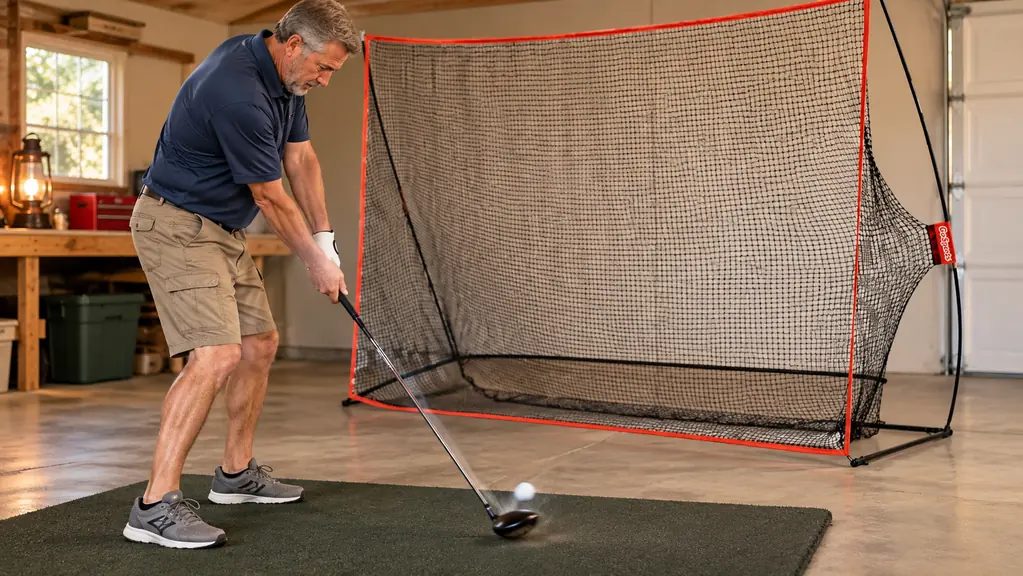
The 10 by 7 foot version weighs 20 pounds and the whole thing packs into a carry case that comes with it. You get the net, the case, a target panel, four tent poles and five metal frame pieces. The material is nylon and the shape is rectangular, which sounds like a strange thing to specify until you have hit into a net that sags in the middle. This one does not.
I measured my bay before I ordered and I would tell anybody to do the same. The net face is 10 feet across and 7 feet tall, so it wants a wall that width, plus enough clear floor in front of it that a 6-iron swing does not put the club into a shelf. My bay is 11 feet wide and I set the net roughly 9 feet off the back wall so the panel has somewhere to give when a ball hits it. The 7 by 7 ft version would have fit in a tighter corner, but a wedge off a mat climbs higher than you would guess from looking at the thing, and I did not want to be the guy explaining a ball mark in the drywall to his wife.
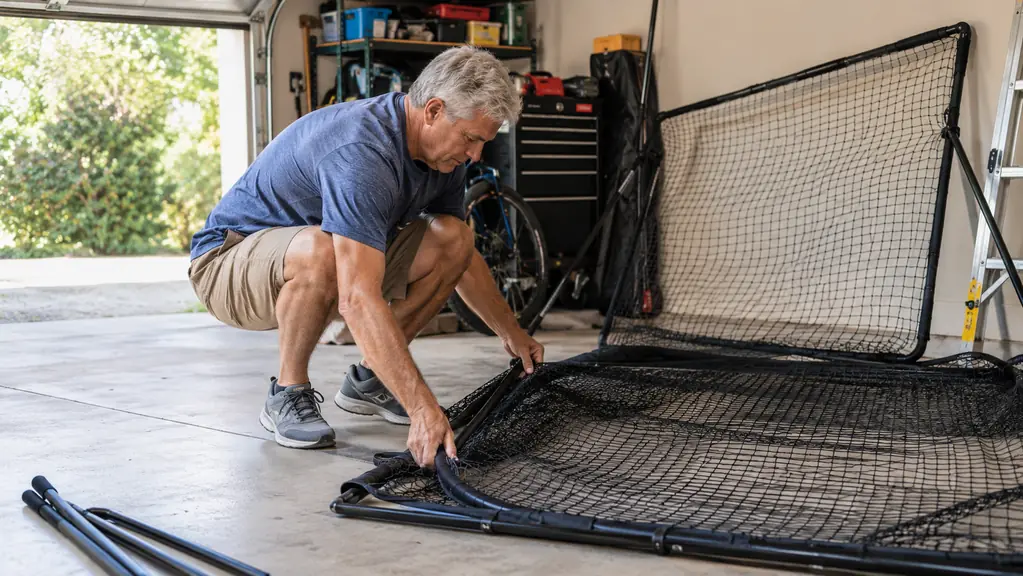
Setup the first time took me and a neighbor about forty minutes, mostly because we were figuring it out. The second time, moving it across the garage, took ten. The four tent poles run up through sleeves in the net and the metal frame pieces form the base and the uprights. It is not a complicated object. It also is not a one-person job the first time you do it, and I would not pretend otherwise.
The 10 x 7 ft size is the one that catches the high wedge
A 7 foot net catches everything below the top of the frame. The 10 by 7 catches the ones you sky. GoSports makes both, and this is the one I would buy again.
Amazon See the 10 x 7 ft Net on Amazon →How It Held Up Over a Winter
This is the part I actually wanted to know before I bought it, and it is the part most reviews skip. After a full winter of three or four sessions a week, the net panel shows no holes. No thin spots I can find by pushing on it. The stitching around the perimeter where the panel attaches to the sleeves is intact. The target panel, which gets the most direct abuse, is scuffed and dirty and looks exactly like something that has taken thousands of golf balls, but it is not torn.
There was a stretch in January where it did not get above 20 degrees in my garage for nine days straight. I hit through it anyway, coat on, sixty balls a session, and the nylon went stiff as cardboard. That is the exact condition I expected to crack it. It did not crack. The panel was louder and it did not give the same way, and by the time I came back inside my hands were too cold to feel the club, which is its own argument for a heated space or at least a kerosene heater. But the net came out of that week hanging the way it hung in November, and I stopped worrying about it after that.
The frame is the piece I expected to fail and it has not. The base sits flat on the concrete and does not walk. When I hit a thin one the whole net shudders and settles. The metal frame pieces have not bent or rusted, even in a garage that gets damp in the spring. The tent poles have stayed straight. If I have one structural note, it is that the whole assembly is light enough at 20 pounds that a really hard shank into the side will shift it an inch or two on smooth concrete, so I keep the base against the wall and it stopped being an issue.
What it will not do is tell you anything. There is no sensor, no readout, no feedback beyond what your hands and your eyes tell you. If you hit a ball and it feels like a hook, it was a hook. If you catch one flush and the net just swallows it, you felt that. I came to like the silence. For the first month I missed the numbers a launch monitor would give me. By the third month I realized I was paying more attention to contact and start line than I ever did at the range with a screen in front of me.
Sixty swings in twenty minutes, three times a week, in a garage that is forty feet from my kitchen. That is the whole argument for this net.
Where It Falls Short
The mat is not included, and that surprised me, because you cannot hit into this thing off bare concrete without hurting yourself. Budget for a mat or use one you already have. That is a real omission and I would rather say it plainly than dance around it.
The first setup is a two-person job. The net itself does not come down small enough to fit in a car trunk and set up at the park, not in any way I would want to do on a Saturday. It is a garage or basement object, not a portable one, despite the carry case. And it gives you zero information about ball flight, so if you are the guy who wants spin numbers and carry distance, this is not the tool and you already know that.
The last thing is sound. A golf ball into a nylon net in a closed garage is loud, and the first few times I hit one I flinched. Nobody else in my house complained, but I also do not have small children or a dog, and if I did I would think about where I put this.
What I Liked
- Survived a full winter of heavy use with no holes, tears or bent frame pieces
- 20 pounds, straightforward assembly, goes up in ten minutes once you know it
- The 10 x 7 ft size catches high wedges that smaller nets miss
- Comes with the frame, target panel and carry case in one box
- Silent feedback: you learn contact and start line instead of staring at a screen
Where It Falls Short
- Mat is not included, and you need one
- First setup genuinely takes two people and about forty minutes
- Not actually portable despite the case, it lives in a garage or basement
- Loud inside a closed space
- No ball flight data of any kind
Who This Is For
If you are a golfer over 45 with a garage or a basement and a back that does not enjoy a two-hour range trip, this is the most sensible piece of practice equipment you can put in your house. The value is not in the net. The value is in removing every excuse between you and sixty swings. No drive, no bucket, no waiting, no cold ride home. I have gotten more repetition this winter than in the previous three winters combined, and repetition is the only thing that has ever moved my handicap at all.
It also suits a guy working on one specific thing. A backswing feel, a takeaway, keeping the head still. Twenty minutes of short-iron swings in the garage is the right way to groove that, and a net is all you need to do it. If you are between lessons and you want to actually retain what your pro told you, this is how you do it without spending another dime at the range.
The net is the cheap part. The reps are the point.
GoSports has this in the 10 x 7 ft and a smaller 7 x 7 ft. For a garage with a wedge in your hand, get the big one.
Amazon Check Today's Price on Amazon →Who Should Skip It
Skip it if you want data. If your practice is built around a launch monitor or you are chasing a specific spin or carry number, a plain net tells you nothing and you will be bored of it in a week. Skip it if you do not have the space, because a 10 by 7 foot net needs a 10 by 7 foot wall and enough depth in front of it to swing without putting your club through a shelf. Skip it if your back trouble is worse than mine, because swinging on a hard floor in a cold garage is not a prescription for anything.
And skip it if you already know you will not use it. I have bought practice aids I used twice. This one I use because it is four steps from the door and there is no friction to starting. If yours would live in a shed behind the lawnmower, put the money toward range buckets and a lesson instead. That is the honest answer.
The Bottom Line
For what it is, a nylon panel on a metal frame that catches golf balls, the GoSports net is well made and it held up better than I expected through a cold winter of steady use. It is not exciting. It does not make you better on its own. What it does is make practice so easy that you actually do it, and after twenty-five years of league golf I am here to tell you that is the hard part. My swing in April felt like a swing I had been making all winter, because I had been.
Four thousand balls later, it is still standing in my garage
The 10 x 7 ft GoSports net with frame, target and carry case. Add a mat if you do not have one, and plan for a two-person first setup.
Amazon Check Today's Price on Amazon →