
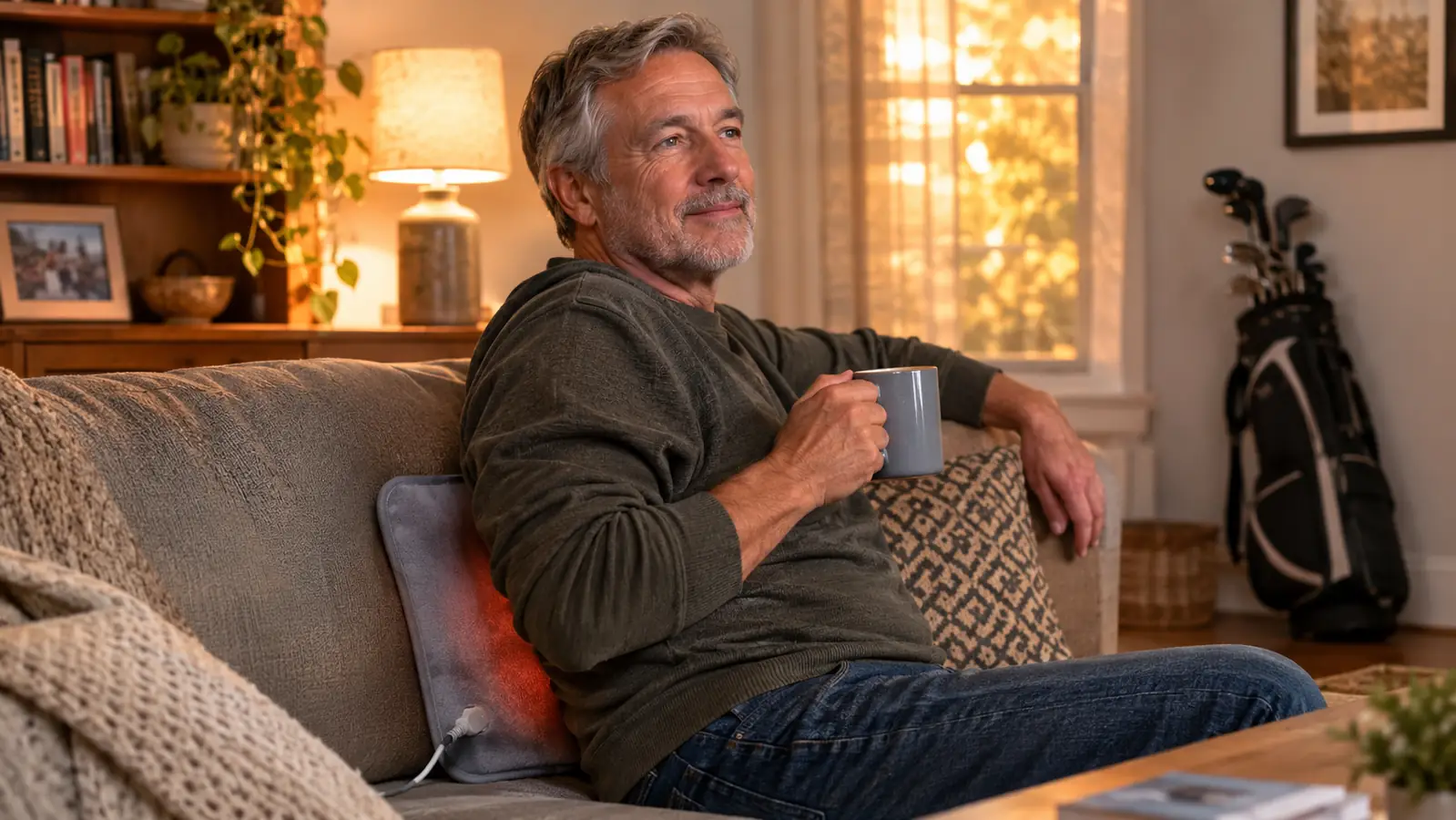
Eighteen holes on a Thursday evening and I feel fine walking to the truck. It's Friday morning that gets me. I swing my legs over the side of the bed, stand up, and my lower back tells me exactly how many times I bent over to tee a ball, rake a bunker, or pick up a wedge I dropped.
I'm 57. I own a sign shop in central Ohio and I've played the same Thursday league for 25 years at a handicap that sits around 14 and has never once shown signs of improving. My back has done this since my forties. My doctor called it ordinary muscle strain and stiffness, nothing surgical, and left it at that.
For years I did the dumb version of the advice he gave me. I'd come home, eat dinner, sit in a recliner for three hours, then wonder why Friday morning felt like a door hinge that had rusted shut. What changed my Fridays wasn't a stretch or a pill. It was a Sunbeam heating pad, the 12 by 24 inch XL one, kept plugged in beside the couch and used on a schedule instead of on a whim.
What follows is the routine I actually run. Five steps, most of them free, one of them requiring the pad. I'm not a physical therapist and I'm not going to pretend a heating pad treats anything. This is about getting a tight lower back to loosen up so you can move, because moving is the part that does the real work.
The one thing I plug in the minute I get home from league night
70 watts, 12 by 24 inches, four heat settings and a two-hour automatic shut-off. Five-year limited warranty. My Sunbeam has been in the same spot on the couch for three seasons.
Amazon Check Today's Price on Amazon →Step 1: Don't Sit Down for the First 45 Minutes
Here's the mistake I made for about ten years. I'd finish the round, drive home, and sit. Recliner, plate of food, television, three hours. By the time I stood up to go to bed my lower back had stiffened into one board, and Friday morning was a negotiation between me and my own spine about whether I was getting up at all.
A muscle that has been contracting for four hours wants blood moving through it. Sitting folds it up and lets it cool in a shortened position, which is the opposite of what you want. The free version of doing something about that is to keep walking for a while after the round. I unload the clubs, take a slow lap around the yard, drink a glass of water, and put the clubs away one at a time instead of dumping the bag by the door.
The first time I tried this, I timed it, because I wanted to know what I was actually getting for the effort. Leaving the course at 8:15 on a Thursday in late May, I was home by 8:40 and didn't sit down until 9:22. That's forty-two minutes on my feet, most of it spent doing almost nothing: carrying a bag in two trips instead of one, hosing off the club faces at the spigot, standing in the garage sorting the wedges back into the right slots, walking to the mailbox and back for no reason. It did not feel like a routine. It felt like stalling.
I'm not describing a workout. It's fifteen to forty-five minutes of not sitting down, and longer is better if you can stand it. Shower, change clothes, then go to the pad. That stretch of staying upright is worth more to my Friday morning than anything else in this article, and it costs nothing.
Step 2: Set the Pad Up Before Your Back Is Already Screaming
The other thing I got wrong early on: I only thought about the heating pad once my back already hurt, which meant I was hunched over a counter trying to free up an outlet while my back was at its worst. Backwards.
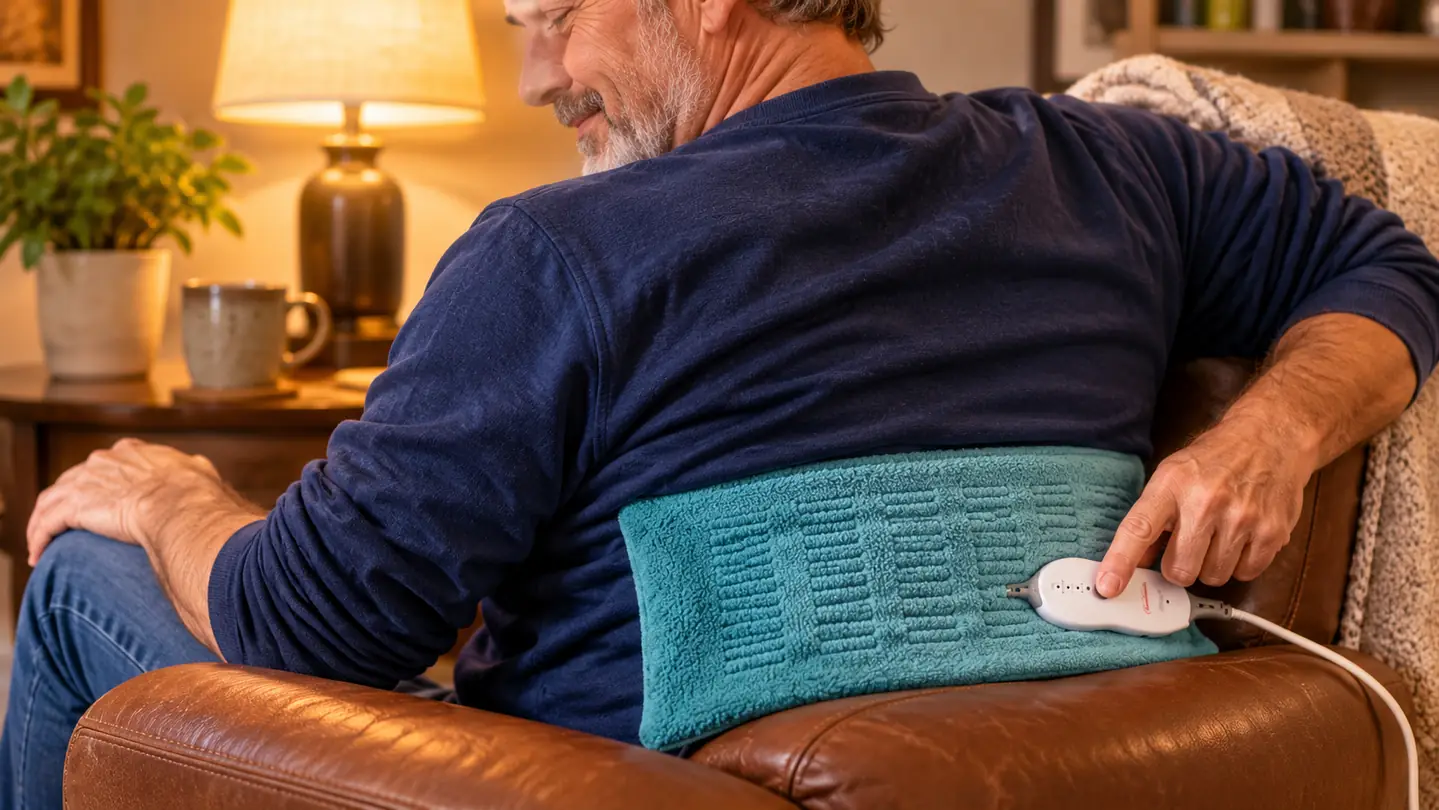
Set it up while you still feel fine. My Sunbeam lives folded on the arm of the couch with the controller on the side table next to it, so the whole thing is one motion. The 12 by 24 inch size matters more than I expected. Laid horizontally across the belt line it covers hip to hip without me having to shift it around. I used a smaller pad for years and spent the entire twenty minutes chasing a hot spot from one side of my back to the other.
The outlet situation is worth ten minutes of thought before you buy anything. I have one outlet behind the couch and it's a reach, so the cord runs behind the cushion and drops down the side. Measure the distance from where you sit to your outlet, then measure again, because the cord is not as long as you think it is when you're picturing it from memory. Getting this wrong is the reason a pad ends up back in the box.
Two practical notes. Don't fold or bunch the pad under you while it's on. There are two heating elements inside it, and bunching pushes all of that into one small area. And keep the controller where your hand naturally falls, not on the floor, because you will want to turn it down before you want to get up.
Step 3: Start Low and Walk It Up
The controller has four heat settings with push buttons and LED lights that stay readable in a dark room. I start on the second setting. If it's still cool through a t-shirt after five minutes, I bump it to the third. I almost never go past that.
Everybody's line is different, and the honest way to find yours is to start low and wait. Skin that's been cold on a windy back nine doesn't register the first setting accurately for a few minutes. Give it time before you decide it isn't enough and jump two notches.
This is also where I learned that the material matters. The microplush cover is soft enough that I use it against bare skin without a towel in between, which I could never say about the old vinyl pad I had in my thirties. That pad got slick and clammy after five minutes and I'd end up with a towel over it anyway, which cuts the heat.
The LED lights sound like a trivial feature. They aren't, at least not for me. Lying on a couch at nine at night, wanting to drop it one setting without turning on a lamp, is a thing I do most weeks from October through April.
Step 4: Fifteen to Twenty Minutes, Then Get Up
The Sunbeam pad has a two-hour automatic shut-off. That's a safety net, not a schedule. Twenty minutes is my number, and I set a kitchen timer for it, because I have fallen asleep under a heating pad before and woke up with a mark on my back and a worse attitude than when I started.
Twenty minutes is enough for the muscle to let go. An hour leaves me stiff and slightly cooked, which is worse than where I began. If you're the type who figures more heat for longer has to be better, I was that type too, and it isn't.
I keep a small notebook in the side table drawer and I wrote down a one-to-ten number for about three months, just to see whether I was fooling myself. Left side of the belt line, Thursday nights, twenty minutes. The number I woke up with on Friday averaged a four in the weeks I used the pad and a seven in the weeks I skipped it, usually because I got home late and told myself I'd do it tomorrow. The gap was consistent enough that I stopped needing the notebook.
Worth saying plainly: high heat increases blood flow to the area, and that's the whole mechanism. It doesn't repair anything. It loosens ordinary tightness so you can move, and moving is what settles a grumpy back down.
Step 5: Move While It's Still Warm
The twenty minutes right after the heat is the good window. The muscle is warm and willing, and that's when a small amount of movement pays off.
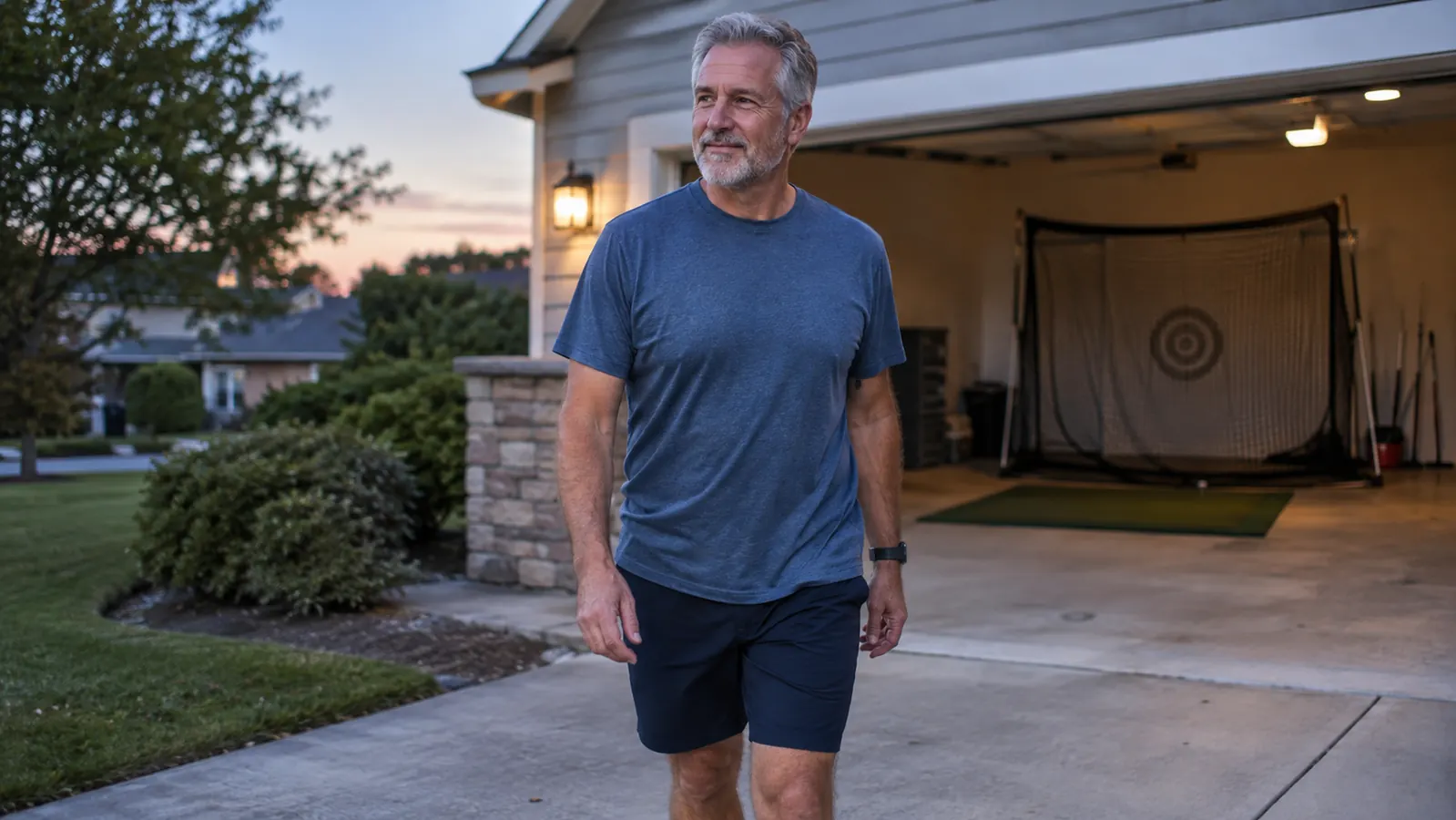
In the garage I take five or six half swings into the net, no ball, maybe half speed, just turning through and letting the back unwind in the pattern it'll be asked to do again next Thursday. Then I walk the strip of backyard where I chip, hands in my pockets, ten minutes, no swinging.
I know exactly how loose I am by whether the third half swing feels different from the first. If the first two are tight and the third one turns through without me thinking about it, that's the signal to stop while I'm ahead. If the fifth one still feels like the first, the back isn't ready and pressing it is how I end up taking two weeks off in the middle of the season.
What I don't do is decide that since my back feels fine I should finally move the drill press at the shop or rake the whole yard. I've made that mistake more than once. The bill comes due the next morning and it comes due in full.
The pad doesn't fix my back. It takes Friday morning from a ten minute negotiation to a two minute one, and I'll take that every single week.
What I Liked
- Four heat settings with a push-button controller that's easy to work without looking
- 12 by 24 inches covers the whole lower back without repositioning partway through
- Microplush cover is soft enough to use against bare skin
- Two-hour automatic shut-off means dozing off isn't a disaster
- Five-year limited warranty, which is more than I expected on a pad
Where It Falls Short
- Runs off a 120 volt wall outlet, so you're tied to one room
- Four settings means four, not a dial you can fine-tune
- The XL size is more pad than a neck or shoulder needs
- The controller is a hard lump if it ends up under your hip
What Else Helps
Walk after dinner. Not a hike, not a workout, a loop around the block. Twenty minutes of easy walking in the evening does more for my Friday than any stretch I've tried, and I have tried a lot of them in front of the television with a golf club across my shoulders.
Look at what you sit on and stand on. I'm on concrete at the sign shop most of the day, then I get into a truck seat that has seen better days, then I sit in a recliner. That's three bad chairs in one day, and no heating pad is going to outrun it. A rubber mat at the shop counter was a cheap fix that punched well above its weight.
The range mat is the other one. I hit balls on a Saturday morning for thirty minutes and then stand on concrete for the rest of the day, and for two days afterward my back is worse than it was after eighteen holes on grass. I finally started cutting that session to twenty minutes and putting a piece of thick foam under my feet at the station, and the Sunday following it stopped being a write-off.
Sleep position matters more than people admit. On my side with a pillow between the knees is the difference between a stiff morning and a bad one. On my stomach is a guaranteed bad Friday, no matter what I did on Thursday evening.
And drink water. I know how that sounds. But a league round in July, plus a couple of beers afterward, plus no water all day, and my back on Friday is tighter than it has any right to be. That one took me embarrassingly long to notice.
When Heat Is the Wrong Tool
Two situations where I put the pad down. The first is a fresh pull. If something actually went in the middle of a round, sharp and immediate, that isn't the tight grumpy stiffness I'm describing, and heat on it in the first day or two is the wrong move. The second is anything with a nerve in it. Pain running down a leg, numbness, weakness, or a fever alongside the back pain is a doctor conversation, not something to manage on the couch with a heating pad and stubbornness.
Start with the free steps. Then plug this one in.
The walk and the twenty minutes are the routine. The pad just makes the twenty minutes count. 12 by 24 inches, four settings, two-hour automatic shut-off.
Amazon Check Today's Price on Amazon →